Links to other sites are highlighted in red.
Conditions of site use are at the end of this page.
Clicking a numbered reference takes you to Notes on a new tab.
You then need to scroll down to the note in question.
But this method is slowly being abandoned
in favour of numbered footnotes at
the end of each dated entry.
You could also view Journal and Notes simultaneously on separate displays.
Read about Henry's ship, the Robert Lowe. Comments are welcomed.
Robert Cutts, bob@winton.me.uk.
THIS BLOG IS CURRENTLY BEING RECONSTRUCTED
During the process, a chunk of it vanished.
Efforts to recover it have been fairly successful
but the process is continuing.
 |
| Advertisement in The Times, 30 June 1862 |
The Journal ...
The Journal ...
... being, an authentic diary kept by my great grandfather, Henry Taylor, during his journeys through the Americas and the Sandwich Isles from September 1862 to January 1867.
About the months of July and August 1862 I read many accounts of the immense wealth of the newly-discovered Gold Fields of British Columbia and became dissatisfied with my position and prospects. I was then a Clerk in the employ of Hepworth and Co, Princess Street, Manchester. The exaggerated reports of the extreme amount of gold which had been taken out of the Caribou during the season of 1861 so excited my almost dormant spirits that I longed to exchange the monotony of a counting house life for the wild and uncertain life of a miner. It is true I was but a boy, "only nineteen years old" they said, and my constitution little calculated for the wear and tear of such a change as I proposed to make. But my mind was made up to leave England, home and all their many happy associations the value of which I could never learn until estranged from them by residence in foreign climes.
About the months of July and August 1862 I read many accounts of the immense wealth of the newly-discovered Gold Fields of British Columbia and became dissatisfied with my position and prospects. I was then a Clerk in the employ of Hepworth and Co, Princess Street, Manchester. The exaggerated reports of the extreme amount of gold which had been taken out of the Caribou during the season of 1861 so excited my almost dormant spirits that I longed to exchange the monotony of a counting house life for the wild and uncertain life of a miner. It is true I was but a boy, "only nineteen years old" they said, and my constitution little calculated for the wear and tear of such a change as I proposed to make. But my mind was made up to leave England, home and all their many happy associations the value of which I could never learn until estranged from them by residence in foreign climes.

Detail from The Lindsay Fleet, a painting in the Swedish Maritime Museum. Unknown artist.
Please do not download or embed the image.
I took passage on the steamship Robert Lowe,1 1478 tons and 300 horse power, and sailed from Shadwell Basin, London Docks, at 3.00 pm on the ever memorable 15th of September. It was at that hour that the most bitter pang of parting was felt by all those who were leaving behind them those more or less dear ones. The parting with my dear Mother, who stood on the dock lost in tears and fearful anxiety for my future welfare, was indeed a severe one.
My mind was almost changed and I was half inclined to retrace my steps ere it was too late, but the thoughts of the ridicule I should incur and the dread of again returning to the drudgery of a desk prompted me to go. And go I did. May the Great Ruler of the Universe be pleased in his infinite mercy to spare my dear Mother to see the return of her only son.
1 The SS Robert Lowe (1854-1892) was an 86 HP iron screw-assisted sailing ship built by Scott & Co of Cartsdyke, Greenock. Her tonnage was 1250 and her dimensions were 240.5 ft by 33.9 ft by 18.7 ft. For most of her early life she was commanded by Captain William Congalton under the flag of W S Lindsay & Co. In 1870 her engines were removed and she was renamed the Iron Cross. In 1891 she sank in the Baltic Sea near Stockholm. She outlived her first owner, William Schaw Lindsay, by 14 years.
September 15th 1862
1 The SS Robert Lowe (1854-1892) was an 86 HP iron screw-assisted sailing ship built by Scott & Co of Cartsdyke, Greenock. Her tonnage was 1250 and her dimensions were 240.5 ft by 33.9 ft by 18.7 ft. For most of her early life she was commanded by Captain William Congalton under the flag of W S Lindsay & Co. In 1870 her engines were removed and she was renamed the Iron Cross. In 1891 she sank in the Baltic Sea near Stockholm. She outlived her first owner, William Schaw Lindsay, by 14 years.
September 15th 1862

We got down as far as Gravesend and cast anchor to be in readiness to receive those passengers who, wishing to delay their departure from the home circle as long as possible, intended embarking with us on the morrow. I went ashore for an hour or two supposing it would be the last time my feet would touch terra firma for some time.
Being an inexperienced traveller, the idea of sleeping in a miserable bunk of wood, along with some seventy others, was anything but pleasant. Nevertheless I slept and dreamt of nuggets of gold in a homeward bound ship.
September 16th 1862
Being an inexperienced traveller, the idea of sleeping in a miserable bunk of wood, along with some seventy others, was anything but pleasant. Nevertheless I slept and dreamt of nuggets of gold in a homeward bound ship.
September 16th 1862
The rest of the passengers embarked. One of the steerage passengers changed his mind, sold out cheap – bag and baggage – and went ashore. He was laughed at, but who knew the motives that influenced his decision. Perhaps it would have been as well if many others of us had followed his example.
September 17th 1862
At 4.00 am we left Gravesend with a pilot aboard and proceeded about 25 miles down the river when we met with a slight accident to our screw and were obliged to return to repair the damage. Our Chief Engineer went ashore in the steam tug and returned with one of that amphibious race, a diver. I then had the opportunity of witnessing for the first time the modus operandi of this strange individual. He remained below for 14 minutes making observations. What he reported when he came on deck, I was unable to ascertain, beyond that it was necessary for him to go down again next day.
September 18th 1862
The diver went down again and completed the repairs after which we left Gravesend once again.
September 19th 1862
We passed the Albion Cliffs of Dover and about 9.00 pm we saw the lights in the town very distinctly.
September 19th 1862
 |
| The Albion Cliffs of Dover from offshore(Steven Penton, Wikimedia) |
September 20th 1862
On going on the deck in the early morning we found that we were out of sight of land.
September 21st 1862, Sunday
We mustered on the quarterdeck and a service was performed by our fellow passenger, the Rev Reece.1 He, along with his wife, had taken passage with the intention of establishing an educational college in Victoria. Oh! How imposing was this service and how familiar to almost everyone on board. What deep reveries it caused us to fall into and how many happy Sundays were remembered when, in the company of those near and dear to us, we had united in Praise and Prayer in the Sanctuaries of "Dear Old England."
Until today we have had really glorious weather, a smooth sea and no rain, but the elements of wind and rain seem only to have been caging up their violence to unite in one fearful outbreak and now, for the first time, the dreadful effects of going to sea are visible on every hand. "All hands and the cook" are sick. It is true that some of the lucky ones escaped, but Neptune is a hard toll collector and very few can cross his path without paying him his due! It is a most disgusting sight. And how those cruel sailors did tease us poor land lubbers: "Wait a minute – we'll put you ashore in the long boat!", "Aren't you sorry you came to sea!", "Hurrah for Caribou!" and similar consolation was all we got out of them. I held out bravely until evening when I found it was indispensably necessary that I should "give way to my feelings" to use a very mild form.
1. Henry erroneously spelt Reece as Reese. I have corrected it in this on-line version. The passenger list of the Robert Lowe published in the British Colonist of 12 January, 1863, includes the Rev W S Reece (rather than Reese) as the only clergyman aboard. William Sheldon Reece served under George Hills, the first bishop of British Columbia, and was involved in the acrimonious dispute between Hills and Edward Cridge, the Chaplain for the Hudson's Bay Company in Victoria, who had been in Victoria since 1855. In 1868 Reece was appointed Archdeacon of Vancouver and was based in New Westminster (before it was replaced by Vancouver as British Columbia’s most important town). In 1873 Reece reported to Bishop Hills “in an advanced state of drunkenness”. Either voluntarily or as a result of dismissal by the bishop, Reece returned to England where he served as a curate or perpetual curate (19th-century equivalent to vicar) in various parishes for the rest of his life.
September 22nd 1862
The weather was little or no better. The greasy pea soup was not sufficiently tempting to my appetite, so I was obliged to go with a very empty stomach, much to my disgust.
September 23rd 1862
When I awoke I felt hungry and dived eagerly after some of the little delicacies I had brought from home and during the rest of the day I felt tolerably well. My bout was comparatively short, seeing that some of my fellow passengers were sick for more than a month.
October to December 1862
 |
| A concert on deck |
To the rest of the voyage little or no interest can be attached, unless indeed monotony is interesting. We had on board some good amateur singers and it was the custom, in fine weather, to hold concerts on deck. Such social meetings were bright oases in the great desert of our four months' voyage. Enjoying them we could shut our eyes to the past, to the future, to our dangerous position, thousands of miles from land, the fathomless ocean beneath us. All were forgotten. What mattered it to us that we were all portionless adventurers seeking the wherewithal to make life's closing years not only endurable but happy. Many of us remembered an {10} old song which I had often sang with my dear father:
High feasting makes us earthly,
Nor ever helps us rise.
Deep drinking drowns the spirit,
And keeps us from the skies.
Loud mirth is false and hollow,
Nor makes us happy long.
But would a man be merry
Why, let him sing a song.3
Boxing gloves and sword sticks were in great demand for a while but, getting out of order, had to be laid aside long before the termination of the voyage.
We had aboard as cabin passengers a Mr Wood4, his wife and two grown up daughters, the younger of whom – Miss Ellen – was considered the most handsome and accomplished young lady aboard. Possessing such attractions as were hers, and shining with such bright effulgence as she did, in a community which was debarred from the ordinary social intercourse of life at home, it was not remarkable that she should have admirers. Amongst such were two lower deck passengers one Frank Passingham and the other "Garibaldi" Thompson, as he was familiarly called to distinguish him from two others of the same name that were with us in the steerage.
Garibaldi was a man of an age which it would be unsafe to surmise. However, according to his own account, he had held a commission under General Garibaldi in the Italian Campaign – hence his nick name. He said he had performed many valorous deeds to aid in rescuing Italy from her tyrannical oppressor. In spite of all this he was generally considered to be slightly deranged in his upper story. Passingham was a youth of some eighteen years, possessing hair of such a brilliant hue as to gain himself the very significant cognomen of "Carrots". He was tolerably witty and considered more than ordinarily intelligent.
It was arranged between the friends of Passingham and those of Thompson that the latter should write to the former a letter demanding a surrender of all claims to the affections of the young lady in question or a choice of weapons! In reply Passingham most peremptorily refused the first request and went on to mention the name of his "Friend" whom he said would make arrangements to bring about a mutual settlement of the affair with the aid of a brace of persuaders in the shape of single barrelled pistols! Seconds were chosen and it was arranged that the "little meeting" should take place on the forecastle at 5.00 am. In the month of; December and in the vicinity of Cape Horn, we could only expect it to be pitch dark at the hour indicated.

Punctual to the minute, the rival lovers met amid the cheers of eighty sleepy mortals who were eager for the fray. It would not be out of place here to mention that it was arranged between the seconds that nothing but blank cartridges should be used. At the same time Thompson was kept in happy ignorance of this fact.

Ten paces were measured and the word was given.

Thompson turned deadly pale as, after his shot, he saw his antagonist fall – pierced, as he thought, to the very heart.

When a young medical student, Dr Brown, pronounced with greatest gravity that the wound was mortal and that the patient could not possible survive, visions of being placed in irons in the main hold, with a diet of bread and water and a pallet of straw followed by a trial and Sentence of Death on reaching Victoria, all passed rapidly through Thompson's much excited brain.
The report of the pistols had brought on deck, en dishabille [in their underwear], the Captain and several of the After Passengers. Of course the ball was up, and when the cause of the affair became known in the cabin, Miss Ellen, who bye the bye had never exchanged a sentence with either of the "Duellists", blushed and declared her approval of the brave manner in which "Mr Thompson" had endeavoured to maintain his imaginary right to her hand.

Ever after this occurrence, poor Thompson was made the butt of ridicule and the subject of almost every practical joke. On arriving in Victoria he commenced keeping school but, not meeting with much encouragement, gave way to despondency and, poor fellow, was found one morning suspended by his braces to the beam across his humble dwelling a stiff, discoloured corpse5.
Every Sunday we had Divine Service on the quarterdeck in fine weather or, when unfavourable, in the saloon.
Among our "precious" freight were 36 Female Emigrants from Lancashire – sent by the Emigration Society in London6. They were during the passage kept under the strict surveillance of the Captain, the Surgeon and our Minister. They were not allowed to associate themselves with any of the male passengers. On our arrival in Victoria, they were properly cared for until places suitable to their abilities could be procured. Within a week they were all at work. Afterwards some of them married well – much better than they could have been expected to do had they remained in England.
 |
| Sea Captain by Yoo, Choong-Yeul |
Our Captain, Mr Congalton7, we found to be a very fine man. Though entertaining rather aristocratic notions, he was ever ready to hear any complaints the passengers might have to make, and he was always willing to give us the full benefit our position entitled us to. We had every confidence in his ability as a skilful seaman for, more than once, we had the opportunity of seeing that he knew what he was about. He could keep cool in moments of the most imminent danger for, although the passage was on the whole a pleasant one, we had several severe gales and squalls during which we often did on our knees commend ourselves to Him who holdeth the winds in His hands and who rules the vast oceans as well as the Earth.
 |
| Under the Mast |
When our gallant craft was tossed like a cork upon the bosom of the mighty deep, when the winds howled through the shrouds, the waves washed mountains high "till with the hurly, Death itself awoke" – then was it that we felt our utter dependence on God.
We saw large shoals of whales, porpoises, blackfish, grampuses and flying fish. We managed to harpoon one porpoise from the jib boom. The flesh was cooked and, as a change, was anything but disagreeable to the palate.
Coming round the dangerous Cape Horn we were accompanied for a week by numbers of Cape Hens and Cape Chickens, whose presence somewhat relieved the dull monotony of sea and sky. During the voyage we sighted Madeira, the Canary Islands, Staten Island [off Cape Horn] and Pernambuco [a province of NE Brazil].
| 1762 map of the Strait of Magellan and Tierra Del Fuego by Emmanuel Bown Staten Island (Isla de Los Estados) is on the right (Victory Adventure Expeditions) |
The magnificent sunsets, to be seen only in the tropics, were the subject of wonder and admiration. Had an artist in England painted scenes of such grandeur, displaying such gorgeous colours and such remarkable combinations of effects, those who had never seen such scenes would have accused him of over-exercising his imagination. Nevertheless how we longed for the powers of an artist to transfer these glorious sights to canvas!
In the latitudes of Cape Horn no amount of clothing was too much. We could pile coat upon coat and still call for more. The days were dark and gloomy and, although it was the Summer of the Cape, we were for weeks without a glimpse of either Sun or Moon.
Christmas Day was, as with Englishmen everywhere, a great day. On that day we feasted ourselves on fresh beef, procured from the flesh of a poor consumptive old cow which was so far gone as to render it a mercy that she should be massacred. That tough pound of beef was far more acceptable to us than a fine old English Christmas Dinner at home. We did our best to be happy and to spend a "Merry Christmas" but our thoughts would inevitably fly back to the firesides of the homes we had left so far behind.
January 8th 1863
 |
| The Cape Flattery Light (NOAA's Sanctuaries Collection via Wikimedia) |
At 2.00 am we sighted the Light House of Cape Flattery and the same day entered the Straits of "Juan de Fuca"8.
What a sight for us "Britishers"! On each side of the straits, towering almost to Heaven, cloud capped mountains covered with snow met our admiring gaze. Forests of pine and the huts of the native Indians were also visible and were objects of great interest to us. It was then that we began to speculate on the prospects before us. Our long dormant energies were awakened and the reality of our position was fully realized by every one.
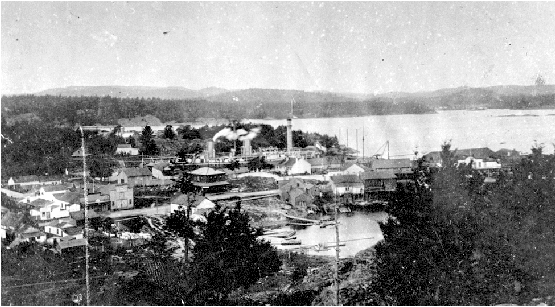 |
| Esquimalt Harbour, 1858 (Victoria University) |
January 10th 1863
 |
| HMS Topaze in the 1860s (Hastings, George Fowler collection via Wikimedia) |
January 11th 1863 (Sunday)
Few of us slept much during the previous night for we were anxious to catch a glimpse of the harbour in which we were so snugly moored. When daylight came we were, to our relief, much gratified by the sight. It would be useless for me to try to describe the beautiful harbour and the magnificent scenery surrounding us. It is said to be one of the grandest sights of the Pacific. The water was smooth as a mirror for not a breath of breeze disturbed its surface. The only sounds which greeted our ears were the sharp shrill cries of the hundreds of wild duck and other birds watching very intently for any scraps of bread that might be thrown overboard and the jabberings of the Indians in their canoes alongside, using their utmost endeavour to supply everyone aboard with a large stock of fish.
 |
| Henry Taylor's Journal – reaching Victoria |
Being Sunday, it was of course necessary that we should wait until the following day to be transported en masse to Victoria11. A number of us decided upon going ashore and walking to Victoria – a distance by land of about five miles. Accordingly a party of about twenty of us started on an exploring expedition and, after a long walk over a rough, half finished road, we reached the capital of Vancouver Island. We found it in a very dirty condition and had great difficulty in making headway through the streets, which were literally ankle deep in mud. Instead of pavements of flag or stone, they just have wooden side walks, and these were in such a fearfully dilapidated condition as to render them quite dangerous.
[The passenger list of the Robert Lowe is at the end of the Journal].
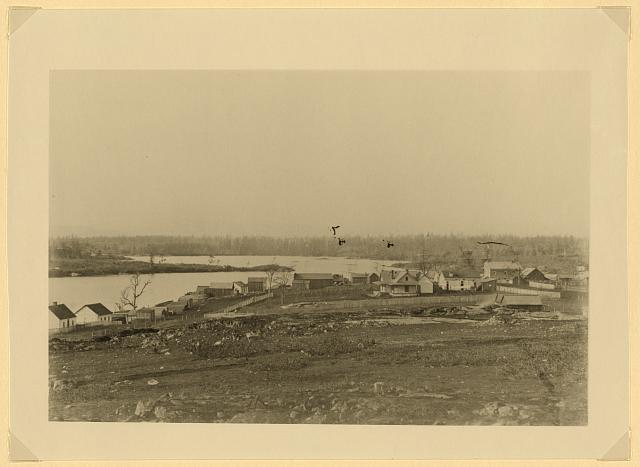 |
| Victoria in the mid 19th century (From the Islander) |
With very few exceptions, the buildings of the city are constructed from wood. The St Nicholas Hotel, Government Street, and the bank of the British North America are the largest brick and stone buildings on the Island. We found several good wharves, all built on piles driven into the bay. The largest of these belong to the Hudson's Bay Co who, bye the bye, are the largest and most influential people on the colony. The Governor of the Island, Sir James Douglas, resides near Government House. He is a man much respected, both by natives and foreigners.

| Indian Camp at Fort Colville, Washington Territory Painting by Paul Kane c1860 (Wikimedia) |
Outside the town are many Indian Encampments. Most of the natives prefer the natural wild mode of life to that of a few of their tribe who, becoming a little civilized, have bought or rented shanties in town. Their language is a strange gibberish composed of a mixture of English, French and Indian words. It is easy enough to learn and to pronounce, but the critters, as they are called, seem to have a decided objection to learning English. They manufacture matting, baskets, small canoes and the like. They peddle their wares through the streets and thereby make a little money wherewith to purchase some of the little delicacies more familiar to their white neighbours. They are, as a general thing, exceedingly filthy and lazy in the extreme. The mode adopted by their women for carrying their offspring is perhaps a pleasanter one than the one used by Europeans, if not quite so elegant. They strap them tightly on their backs, or carry them in a basket fastened on their backs by strong cords, thus leaving both the arms of the mother at liberty.
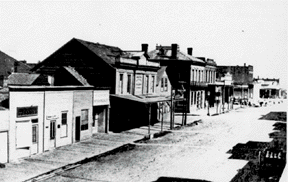 |
| Theatre Royal, Victoria in the 1860s (Victoria's Victoria) |
There are many restaurants and drinking saloons in the City. It is a fact that impresses itself at once on the mind of every one arriving from the old country, that the colonists patronise this class of place much more than the people at home. There is also a theatre here, but I am sorry to say that the patronage of Europeans and Americans is of so little account that it will pay no manager to keep a good company. However, the Indians, both Siwash and Klootchman12, may be found there nightly. Though able to understand hardly a word of the dialogue, they love the gaudy dresses. Their taste in this line almost amounts to monomania. They may be found in the streets with an old red blanket thrown around their heads, adorned by an old hat, once the possession of a sailor or soldier, now stuck full with coloured plumes. For a pair of red pants or a soldier's jacket they will do anything, with the exception perhaps of washing themselves or combing their hair. To these occupations they entertain an almost religious aversion.
As my stock of finance was rather limited, I began to look out for an occupation and at last got something. It hardly enabled me to live the life I was accustomed to at home, but I betook myself to it as cheerfully as possible. I was hired at $1.25 a day, board not included, to work at road making about four miles out of town on the Saanich Road. We had a tent of fir boughs to sleep in (and on!) and a large log fire in front, to cook by. This was pretty rough in the depth of winter, with snow four or five inches thick on the ground and the water covered with ice. I stayed at that till we got clean frozen out and the work had to be stopped. Returning to town I managed to obtain a situation as assistant bookkeeper with J G Little in the Wood and Coal business.
March 23rd 1863
I sailed in the Adelaide Cooper13 for Port Ludlow14, Puget Sound in Washington Territory. The Captain of the barque was a Mr. Dingley. The voyage took five days. We first crossed the Straits to Port Angelos [sic] and, thirty miles on arrived at Port Townsend, a miserable apology for a town.
 |
| Port Townsend in the 1860s (HistoryLink.org) |
At that point we entered Puget Sound and thirty miles further on we came at last to Ludlow. This place is on a spit – a small projection of land. It is occupied almost solely by a sawmill where some seventy hands are employed. They daily manufacture lumber, which is shipped to California, China and Australia. I went to work in the mill of Amos Phinney and Co at $50 per month, with board. Tending the bar at the Hotel, I found Harry D Thompson, a comedian who I had often seen at the Theatre Royal, Manchester. He is the brother of Miss Lydia Thompson of the Lyceum Theatre15, London.
May 6th 1863
Went to Port Gambol (sic) in the schooner “Black Hawk”.
May 9th 1863
Returned to Ludlow in a canoe with two Indians.

Note
On entering the Straits of Juan de Fuca from the open Pacific we leave the revolving light at Cape Flattery on the right-hand side. The shores of Vancouver’s Island on one side and Washington Territory on the other are visible. On the American side we see nothing for miles but snow-capped mountains. Chief amongst these stands Mount Baker, the summit of which is covered with perpetual snow. Gradually, as we proceed up the straits, the landscape unfolds itself. The various undulations then revel themselves as being immense forests of fir and maple. On the British side we see no snow-clad hills but dense masses of fir so thickly set that we wonder how it is possible for them to grow. We see on neither side any signs of human habitation for upwards of 100 miles from the lighthouse at Cape Flattery.
Next we come to Race Rocks with another beacon. Next comes Esquimalt Harbor, with H.M. Frigate “Topaze” and the gunboats “Grappler”, “Devastation” and “Forward”. Seven miles further on we come to Victoria Harbor. But as there is no safe anchorage for large vessels here, it is mostly used for smaller craft.
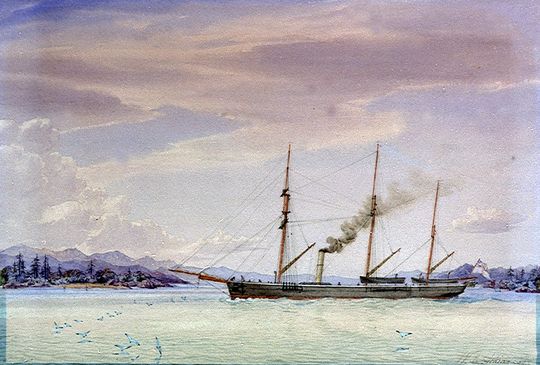 |
| H.M.S. Grappler (University of Victoria) |
We next leave the straits and come to Puget Sound, the Custom House at Port Angelos. 25 miles higher up is Port Townsend, a miserable apology for either city, town or village. 35 miles more and we reach Port Ludlow where I staid [common 19th-century spelling of stayed] for some time. This place is called a “spit”. It is a small projection of land occupied almost solely by a sawmill where some 70 hands are employed daily manufacturing lumber which is shipped to California, China and Australia.
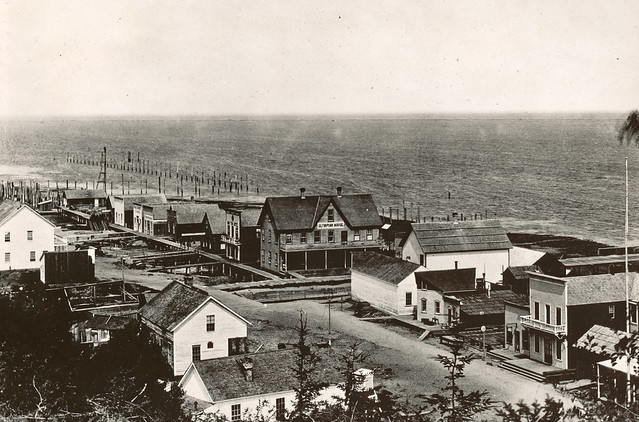 |
| The Custom House at Port Angeles in 1910 (Flickr, James Wengler) |
A few miles from the mill, just across the narrow sound, I visited an Indian Burial Ground, a sight of considerable interest. Here, raised some six or seven feet from the ground on slender trees, are suspended old dry goods boxes, containing the last mortal remains of many a Chinook Chief. The bodies are doubled up and wrapped around with old matting before being enclosed in the rude boxes. Suspended round these singular sepulchers are old blankets and clothes formerly used by the deceased. On the tops of the boxes are the tin plates, pannikins, fishing lines and other articles formerly used by them.

| The Pope & Talbot, Inc. Sawmill Site in 2011 (Washington State Department of Ecology) |
 |
| The same sawmill in the 1860s (HistoryLink.org) |
 |
| Water Street, Port Townsend, 1862 |
Editorial note: Water Street is still in Port Townsend
as can be seen in this shot taken by - - - - :

Seven miles farther up the sound we come to Teekalet, or Port Gambol, which, like the rest of the ports in the sound, Port Gambol is occupied by a sawmill – this one belonging to Pope and Talbot.
The other ports in the vicinity are Olympia, Utsalady, Siebec, Steilicoom, Discovery, Madison and Thompson.
The scenery of the Sound generally is strangely wild and singularly picturesque. Strawberries, raspberries, blackberries, gooseberries and currants abound in large quantities. Wild flowers and unusual ferns are also abundant.
Resumé
June 21st 1863
Left Port Ludlow for San Francisco, California, in the barque Adelaide Cooper with 250 lengths of lumber and two large spars. I had shipped to work my passage before the mast. We anchored at Port Townsend the same evening.
June 24th 1863
Cleared Cape Flattery and, after a pretty rough passage of fifteen days, on July 5th we anchored in 45 fathoms in San Francisco Bay.
 |
| Fort Point & the Golden Gate – the entrance to San Francisco Bay – long before the Golden Gate Bridge was built (What I saw on the west coast of South & North America & the Hawaiian Islands, H Willis Baxley, 1865) |
On the following day we landed and I took up abode at Pacific Temperance House, Pacific Street.
July 9th 1863

Went across the Bay to Hayward in Alameda County, returning to the City on July 21st.
August 15th 1863
Sailed upstream for Antioch on the steamer Cornelia. I went to sleep during the passage and did not wake up until after we had passed my proposed destination.
August 17th 1863
 |
| General Patrick Edward Connor (Wikimedia) |
Landed at Stockton at midnight. Left on the same boat at 4 pm with Brigadier General Connor, bound for Salt Lake City, on board. Arrived at Antioch at 9.00 pm and took stage to G H Hammon’s at Pittsburg, Contra Costa.
September 8th 1863
 |
| The Paddle-Steamer, Helen Hensley (MacMullen, Jerry, Paddle-Wheel Days in California, Stanford Univ Press, 1944 via Wikimedia) |
Returned to San Francisco on the steamer “Helen Hensley”.
November 18th 1863
Left San Francisco on the schooner "Louisa Harker" bound for Vallejo, Solano County, across the San Pablo Bay.
November 19th 1863
 |
| Courtesy of the Bancroft Library, University of California, Berkeley |
Arrived at Vallejo Steamboat Landing at 5.00pm.
November 30th 1863
Was introduced George Edgar16, a cockney, whom I afterwards found to be a perfect gentleman. He keeps the largest and most respectable saloon in town and is highly respected by everyone who knows him. Went to work for him as a bar keeper and had a very good situation of it while the Russian Fleet of five vessels was lying at Mare Island Naval Yard.
December 23rd 1863
Attended a performance by the Amateur Dramatic Club of "Charcoal Burner" and "Rough Diamond".
February 3rd 1864
Wrote Mr. Briggs.
February 4th 1864
Left Mr Edgar's employ and commenced ranching with Mr T J Johnston, a very fine fellow belonging to Virginia.
[On March 11th, though not reported by Henry, there was a slight earthquake in the City at 9:15 A.M. A portent, perhaps, of what was to come 18 months later].
April 23rd 1864
Left the ranch and went to ship-keepers mess on Mare Island.
 |
| U.S. Coast Survey Steamer 'Hassler' at Mare Island Navy Yard (Courtesy of the Bancroft Library, University of California, Berkeley) The 'Hassler' was probably similar to the 'William and Mary' on which Henry took service a couple of months later. |
[On May 20th though again not reported by Henry – maybe because he was away from the City – there was another earthquake during the day with very severe shocks, causing people to rush into the streets].
May 21st 1864
Returned to the City on the Steamer Amelia.
May 23rd 1864
Went with one Dick Brashears to Crystal Spring Hotel, which is kept by a Yankee named Tony Oakes.
June 6th 1864
Returned by stage trail to the City.
June 13th 1864
Took service on ship for six months as Officers' Steward on the U.S. Surveying Cutter17 William and Mary.
June 29th 1864
Got under way on at 1.00 pm, arriving in Mare Island at 5.00 pm.
July 1st 1864
Left at 1.00 pm on July 1st and anchored at Steamboat Point at 6.00 pm the same day.
 |
| Mission Bay map drawn By V. Wackenreuder, C.E. 1861. (Published by Henry G. Langley for the San Francisco Directory) |
Mission Bay was on the City's eastern shore just south of where the Bay Bridge is now. Note that, unlike modern maps, north is on the right and west is at the top. Even by the 1860s, Steamboat Point was no longer a point as the part of Mission Bay to its west had been in-filled. The original shoreline is shown on the map. The in-filling continued until Mission Bay disappeared altogether. In the mid 1930s the Bay Bridge was built. It spans San Francisco Bay west to east from Rincon Point to Oakland (City and County of San Francisco. Compiled from Official Surveys and sectionalized in accordance with U.S. Surveys.
 |
| Mission Bay, San Francisco in the 1860s (designbythebay.com) |
July 4th (Independence Day)
Fired a salute of 21 guns at noon.
August 4th 1864
Left for Suison at 10.30pm. In San Francisco Bay, sighted the steam frigate “Devastation”, the Russian flagship “Bogatyre”, “Admiral Popoff” and several French men of war, colours dipped.

August 22nd 1864
Left at 8.00am. Becalmed at noon and anchored near Mare Island.
August 24th 1864
We got under way on the following day, arriving in San Francisco at noon. At 3.00 pm set sail again and anchored off Point Penola [Pinole Point on the above map] for a day's surveying.
August 24th 1864
Returned to Suison Bay, dropping anchor there at 6.00 pm near the brig “Fauntleroy”.
August 31st 1864
Left at 2.00pm anchoring at the Navy Yard at 6.00 pm.
September 2nd 1864
Left Mare Island at 1pm and anchored near San Quentin Prison at 7.30pm
September 3rd 1864
 |
| Maguire's Opera House, Washington Street, San Francisco in 1869 (Courtesy of Museum of Performance & Design, Performing Arts Library) |
Got under way and anchored at South Park at 8am. In the evening went to Maguire's Opera House and saw Mrs H A Perry as Mazeppa.
September 14th 1864
 |
| Maguire's Academy of Music in the 1860s (Online archive of California) |
Heard the opera “The Bohemian Girl” at Maguire's Academy of Music with Riching's Opera Troupe with H. C. Peakes, bass, Miss Caroline Richings and Miss Kate Martin the principal vocalists.
September 20th 1864
Got under way at noon and anchored off North Beach at 4pm.
September 27th 1864
Got under way at 11am.
September 28th 1864
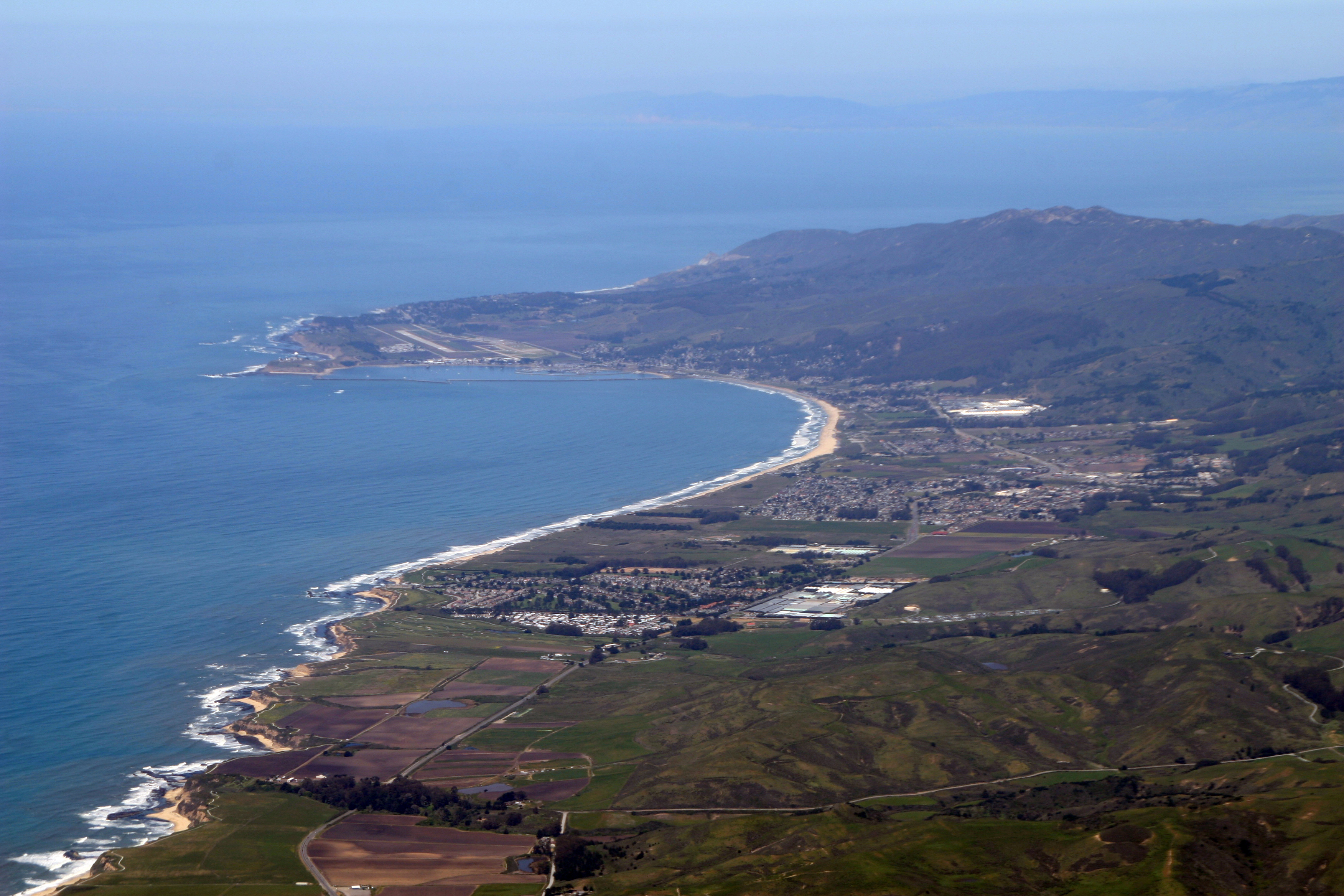 |
| Half Moon Bay, California in 2009 (Wikimedia) |
Anchored in Half Moon Bay at 11am. During our stay here I had some good fishing as tomcods, flounders and the like abound. Also I shot several seals. Went ashore twice and visited the ranch of a Mr Dennison where there were several modern agricultural steam implements. The farm hands were native Californians and Mexicans.
October 7th 1864
Left at 1pm. We were off the Heads in a fog all night.
October 8th 1864
Anchored off Pacific Street Wharf at 3pm.
.jpg) |
| Charles Kean (1811-1868) as Hamlet (Samuel John Stump via Wikimedia) |
.jpg "Ellen Kean (née Tree)") |
| Ellen Kean (née Tree) |
In the evening saw Mr and Mrs Chas. Kean at the Opera House in “Henry VIIIth”
October 11th 1864
Got under way at 11am and anchored at Mare Island Navy Yard at 5.30pm.
October 13th 1864
Left at 8.30am and anchored off Mission Creek at 8.30pm.
October 17th 1864
Saw Mr and Mrs Kean in “The Merchant of Venice”.
October 25th 1864
Went to Mr Richings benefit at the Academy of Music to see the Druids' Scene from “Norma”, a comic opera called “The Doctor of Alacantara” and a "Grand Tableau of Washington" with the “Star Spangled Banner” sung magnificently by the whole company.
October 31st 1864
Spent a very pleasant evening at a party given by Mrs Campbell of Third Street.
November 1st 1864
Went to Miss Riching's Benefit at the Academy to see “The Daughter of the Regiment”.
November 14th 1864
 |
| The Launching of the Comanche (Courtesy of the Bancroft Library. University of California, Berkeley) The 'William and Mary', with Henry Taylor on board, is probably one of the two ships on the far side of the jetty |
The “Comanche”, the first Monitor built on the Pacific Coast was successfully launched. As we lay close to, we fired a salute of five guns. The Hon J P Buckley18 met with a fatal accident during the launch.
November 24th 1864
This is the annual Thanksgiving Day of the American Nation. It is observed here in the same way that Englishmen keep Christmas Day at home – with Family Dinners and evening parties everywhere.
November 29th 1864
December 3rd 1864
Got under way at 7am
December 4th 1864
Anchored at Steamboat Point at 2pm
December 23rd 1864
 |
Montgomery Street, San Francisco, in 1866 viewed from the Eureka Theatre |
Heard the "San Francisco Minstrels" at Eureka Theatre, Montgomery Street. Christmas was very miserable for me. Thoughts of home crowd in on me at this season and I long to rejoin the happy circles round the cheerful firesides of Old England.
December 28th 1864
Left the “William and Mary”.
December 29th 1864
Saw Miss Fanny Brown at the Academy in Pretty Girls at Stillberg.
December 30th 1864
Saw the Pantomime of “The Red Gnome” at Bert's New Idea with some of the best acrobatics I have seen – by Ross and Carlo.
January 1865
 |
| The New York Clipper masthead |
Spent a month soliciting advertisements for “Clipper”19 and “Our Mazeppa”20.
February 13th 1865
Went to Talbot's21 benefit at the Academy. Heard a pretty good minstrel performance and saw Talbot shoot an apple from the head of a young lady at twenty paces using a pistol. On the following day I met two of my fellow passengers from the Robert Lowe – Winter and Mason from the Cariboo and Washoe mines.
February 15th 1865
Spent the evening at Worrell's Olympic.
February 22nd 1865
Shipped as Cook and Steward on the Hawaiian Brig “Nuuanu” captained by Mr Hugui for the Hawaii (or Sandwich Islands).
February 24th 1865
Set sail at noon and the pilot left at 2pm. Had fair and light winds for the whole passage.
March 12th 1865
 |
| Henry Taylor's 1865 map of the Sandwich Islands |
 |
| The Hawaiin Islands as they are now |
Sighted the most southern of the Hawaiian Islands and, during the rest of the day, passed through several others of the group.
March 13th 1865
 |
| Port Honolulu in 1849 (Illustrated London News) |
Sighted the Port of Honolulu at 9am and at 10am a pilot and a Kanaka crew came aboard. By 11am we were anchored.
March 15th 1865
Got my discharge by strategy – and considered it a very good thing. The Captain had been unable to find a cargo and had therefore decided to take ballast to Hong Kong. I had had a miserable time of the passage and therefore thought it much better to stay in a strange land with neither money nor friends than undertake another passage in such circumstances.
March 17th 1865
Commenced work as Steward of the Aldrich House – the biggest Hotel on the Islands – kept by a German, Mr Kirchoff.
March 26th 1865 (Sunday)
Visited the Church of the Catholic Mission, Fort Street. The service was conducted in the Hawaiian language and I found there at their devotions, many male and female natives, and even Chinamen, so powerful is the effect of the few French Emigrants who established this place of worship. After the service I went into the schoolroom under the church where I saw about forty children, all natives, singing English Sunday School songs from the music. Apart from one Englishman, the teachers were all foreigners. The manner, behaviour and general conduct of the pupils was truly exemplary. Many an English class of Sunday School children at home might have benefited by the example of these poor semi barbarian Kanaka children.
 |
| Kawaiaho Church—First Native Church in Honolulu (Northern California, Oregon, and the Sandwich Islands) |
In the afternoon I visited the Native Church, established by an American Missionary enterprise. Here, seated on rude benches, were about 200 natives, all listening with rapt attention to the words of Holy Writ expounded by their minister.
April 26th 1865
.jpg/760px-Raising_of_American_flag_at_Iolani_Palace_with_US_Marines_in_the_foreground_(detailed).jpg) |
| US Marines raising of the US flag at the Iolani Palace in 1898 (Bernice P Bishop Museum via Wikipedia) |
The King of the Islands, "Kamehameha V" gave a large ball at the Iolani Palace in honour of the Officers of the British Frigate "Cleo" and the Russian Transport Ship "Guliack". I was fortunate enough to gain admission to the ballroom through Mr Kirchhoff, who was engaged to prepare the Dinner and Supper.
The large hall, temporarily fitted up for the occasion in the grounds of the palace, was beautifully decorated with a splendid variety of native flowers and rare exotics. Around the building were hung, in very nice style, the flags of many nations – the British and American occupying the most prominent positions. The orchestra was very limited in number, there only being three professional musicians on the Islands. Nevertheless they discoursed some very good dance music.
 |
| King Kamehameha V in 1865 by Charles L. Weed (from the Bernice P. Bishop Museum via Wikimedia Commons) |
His Majesty the King, with the wife of his Prime Minister22, opened the ball. During the ball I observed the Captain of the Russian ship in many evolutions of the waltz with the Princess Victoria, and Mr Synge, H Bell's Consul, with Her Majesty, Queen Emma. The various officers of the two vessels in whose honour the ball was given, in dancing with the various ladies present, were not slow to avail themselves of the opportunity to display the usual English clumsiness.
 |
| Charles Beresford c1880 – still youthful but by then Captain of the gunboat, HMS Condor (Punch) |
Many a gay young midshipman, among them Lord Charles Beresford [who had joined the Navy at 13 and was then 19], disported gaily with stout Hawaiian matrons. Dark skinned young ladies, wearing their most fascinating glances, rivalled each other in attention to their fair skinned partners.
The supper table was most superb in all its arrangements and literally groaned beneath the weight of delicious and beautiful tropical fruits – pineapples, oranges and bananas were piled up in splendid silver and crystal vases. I had the distinguished honour of drinking a glass of "The Good Rhine Wine" from the King's own goblet which displayed the Royal Arms set in precious stones.
April 30th 1865
In the evening I attended service at the Presbyterian Church and heard a very excellent discourse by Rev Mr Corwyn, an American minister of some note here.
May 1st 1865
 |
| General Lee surrenders to General Grant |
The news of the surrender of General Lee reached here from California [it took three weeks to reach Honolulu from Appomattox]. The American Consul at once hoisted his Stars and Stripes and issued a placard inviting American residents to attend Divine Service at once, returning thanks to the Giver of all Good for this signal victory. In the afternoon there was a grand procession and in the evening the town was most resplendent with illuminations.
May 4th 1865
Met two of my fellow passengers from the Robert Lowe – Reddish from Lower California and Burton from Victoria.
May 8th 1865
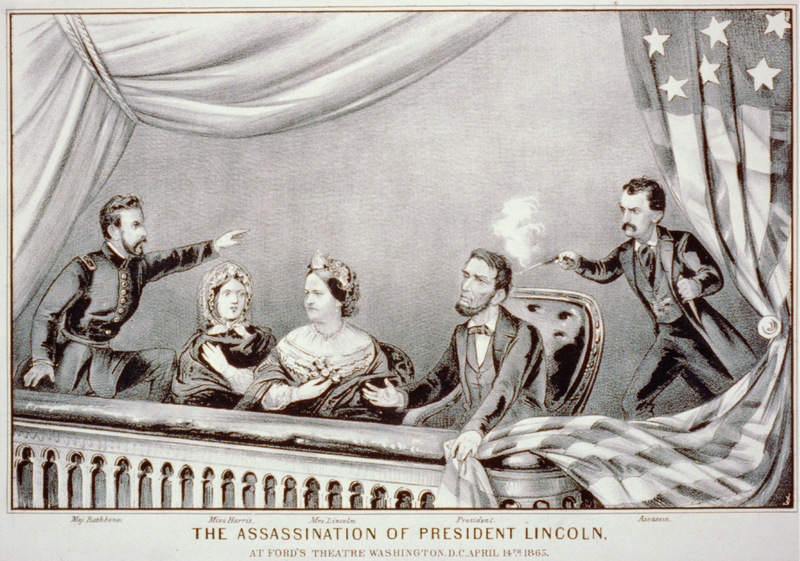 |
| Assassination of Abraham Lincoln at Ford's Theater, 14 April 1865, (Currier & Ives, 1865. via Wikimedia) |
The news of the assassination of President Lincoln reached us by way of the ship D C Murray from San Francisco. Within two hours, Honolulu was completely draped in mourning and the various resident foreign consuls at once lowered their national ensigns to half-mast.
The indignation of Union men was so great at the atrocity of the murder that they were ready to annihilate in a very short time any person on the Island who evinced any signs of satisfaction. From the San Franciscan papers we see that that City had suffered an almost irreparable loss and this was the most important crisis the "Great Republic" had ever seen.
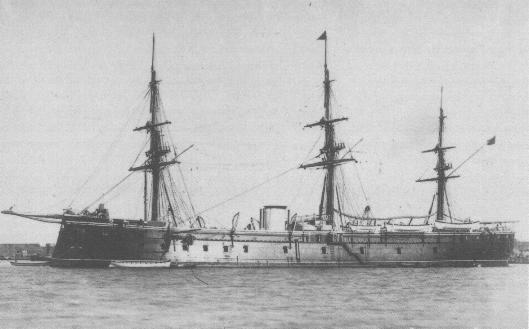 |
| This is the Spanish Ironclad, Numancia – but I've forgotten why I put it here! |
Something of the Hawaiian or Sandwich Isles23.
The Islands are situated on the great highway of commerce between California and China, India, Japan and many Islands of the Pacific. There are twelve islands, four of which are mere rocks. The other eight have the following names and areas in square miles:
 | ||||
| Island | Area | |||
| Hawaii | 4000 | |||
| Maui | 620 | |||
| Kahoolawe | 60 | |||
| Lanai | 100 | |||
| Molokai | 90 | |||
| Oahu | 500 | |||
| Kauhai | 500 | |||
| Niihau | 90 | |||
According to a series of native traditions transmitted through a long line of chiefs, and other conclusive evidence, Europeans, probably Spaniards, visited these islands over two centuries previous to their re-discovery by Captain Cook.
In one of these traditions24 mention is made of a large vessel, named by the natives Konalihoa, visiting there thirteen generations of Hawaiian Kings anterior [i.e. prior] to the visit of the great English Navigator. By some accident this vessel was dashed to pieces by the surf upon the rocks and made a total wreck. The Captain and a white woman, said to be his sister, were the only persons saved. These, being well received and hospitable treated, became content to form connections with the Hawaiians, from whom a mixed and lighter-complexioned race has sprung and from which a large number of chiefs are said to be descended.
 |
| The death of Captain Cook by Johann Zoffany (The National Maritime Museum via Wikimedia) |
Captain Cook was killed by the Natives on Feb 14th 1779 at Kealakekua Bay in the Island of Hawaii.
In March 1820 the first Missionaries (American) arrived there from Boston in the ship "Thaddeus" accompanied by a printer, a physician, a farmer and a mechanic. All had families with them and their wives were the first civilized women who landed on the Islands.
To the labours of these and others equally in earnest, the natives are largely indebted for the amount of civilization they now enjoy.
The Russian Discovery Ship "Rurik" was the first Man of War that ever entered the Harbour. This happened on Nov 21st 1816 [for a record of the Rurik’s visit see http://mauiwebdesigns.com/Hawaii/HawaiiHistory/arussianvisitskamehemeha.htm]
The Captain presented King Kamehameha 1st with a couple of brass field pieces and at the departure of the Russian ship in the following December national salutes were exchanged for the first time in these islands.
On Aug 11th 1822 the first Christian marriage between converted natives was solemnized. In the same year the first experiments in printing were made.
In 1824 the last heathen sacrifice was offered.
There are three seaports on the Islands visited every year by whalers. They are Honolulu on Oahu, Lahiana on Maui and Hilo on Hawaii.
 |
| The view of the hill from Nuuanu Valley ('Sandwich Island Notes', Geo Washington Bates) |
Punchbowl Hill on Hawaii – the national fort at Honolulu situated about a mile out of town – is an old crater, many years silent, mounting some very heavy guns. It is an interesting sight to see a salute fired from its summit on a gala day or on the occasion of the arrival of any man of war in the Harbour. The flash and smoke is succeeded by the heavy boom of the guns and the flags of the Nations represented are saluted.
It was on the large plain island, at the foot of this hill, that I picked up a human skull and, as there are a great number lying round and as tradition tells us there was a great battle fought there some hundreds of years ago, it is not at all improbable that the pate [head] once belonged to some native who fell in the contest.
 |
| An engraving pasted in Henry Taylor's Journal 26 |
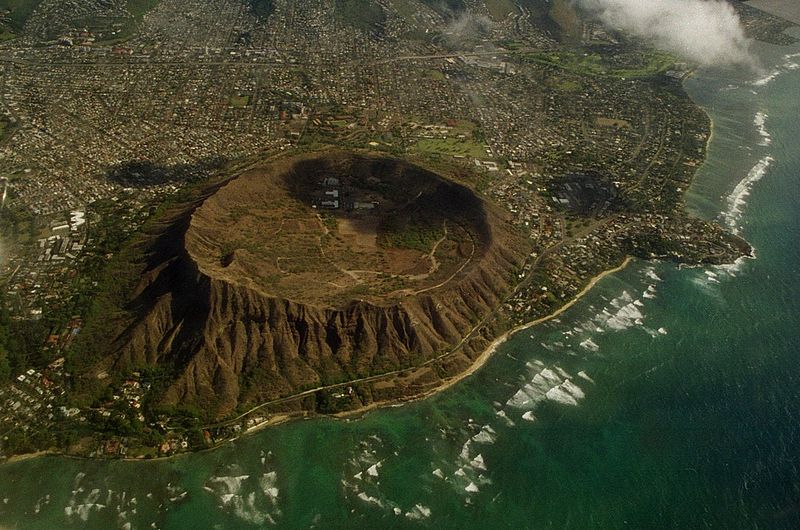
The most prominent headland of Oahu is Diamond Head, situated 4½ miles from Honolulu.
 |
| Diamond Head now (Wikipedia) |
 | |
| Diamond Head The Crater (Wikipedia) |
Often parties will ride or walk from the city and scramble up its side to gain the glorious view that is presented to the eye on every side. On a clear day several of the adjoining islands can be distinctly seen, though at a distance of some 80 or 100 miles.
Returning from Diamond Head you may pass through the pretty little village of Waikiki and here get a native boy to run up a cocoa tree and throw you down half a dozen nuts. You could stop a few minutes in a native hut where you will be met with a pleasant aloha (love to you) their universal salutation of farewell. Or you could rest yourself a while on the clean, cool straw matting spread on the earthen floor and, if you smoke, take a whiff of the native's pipe, which is generally handed round to all visitors, whether native or foreign.
The plain, which lies between Waikiki and Honolulu, is the great playground of the Oahu and, on holidays and Saturday evenings, it is one of the prettiest sights on the Islands. There all the horse racing is done and there the natives who can raise a dollar at the weekend, or who have horse of their own, go and gallop about to their heart's content, until dark.
A sailor, when he goes ashore, is bound at the earliest opportunity, to find himself seated on a native horse for a ride and, as sure as he does so, almost as sure will his experience will teach him, that he is arrested and taken to the Fort (used as a prison) for fast riding and fined five dollars. This being one of the principal sources of Revenue, the Fort is often called the "Sandwich Island Mint" on account of the number of $5 pieces coined from poor Jack every time an opportunity offers [itself]. (A resident can ride as fast as he pleases without running any risk whatever).
Two thirds of the police are native, the balance are of foreign birth.
 |
| An engraving pasted in Henry Taylor's Journal |
At 4pm on Saturday all business is suspended throughout the town and then commences the fun. It is a merry sight to see a party of native women riding through the town, sitting on their horses, as all ladies sat, before side saddles were invented, their bright Kiheis flowing on each side of their horses, their hats jauntingly set on their heads, or in their place, a beautiful wreath of fresh flowers giving you their pleasant alohas as they pass.
The Kihei is a strip of bright coloured print some 4 or 5 yards long and about a yard wide which they take on their arm (without disturbing their dress which is held with a loose girdle when ready to mount) wind it around their waist and, by a magical process, enveloping their limbs, leaving the end to float to the breeze on either side. The ease and grace with which they mount and manage their horses and their perfectly chaste and comfortable riding habit, would excite the envy of many of their fairer-complexioned visitors who love this healthy and invigorating exercise.
 |
| The Pali Precipice in 1948 (Flickr, Tractatus) |
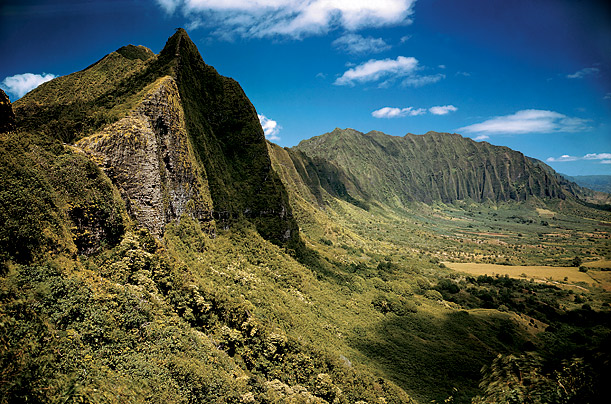
Nuuanu Valley for several miles is one of the pleasantest rides out of town. It ascends gradually until it reaches the height of 1100 feet to the famous precipice (called the Palli) where Kamehameha I first drove the rebellious Oahuams off in former times.
A few miles up this valley the scenery is very fine – turn round and you have a splendid view of the town and harbour. On each side, towering to a height of 2000 feet, you have the large mountains, their sides covered with verdure, giving you a pleasant contrast to the hot, dusty town you have left behind. Before you have a moment's warning, by a sudden turn in the road, your horse (well accustomed to the place) brings himself to a sudden stop and you to one of the grandest pictures of nature you have ever beheld.
Down beneath you drops the precipice before alluded to the depth of 1100 ft. Before you lies the Ocean and the whole of the windward side of the Island. For miles on each side mountains in one vast chain to the height of over 3000 ft making a grand crescent precipice.
 |
| Hawaiians eating Poi (Northern California, Oregon, and the Sandwich Islands, Charles Nordhof) |
On your return to the city you can step again into a native hut (where you are sure to be made welcome) and partake of a little poi.
 |
| Calabashes (R S Gilbert) |
Being acquainted with the manner of eating you can make yourself quite at home and, after washing your hands, squat down tailor fashion, dip two fingers into the Calabash containing the mess, give your hand a twist or two to get sufficient poi for a mouthful and swallow it at ease. The Poi is a paste made from the root of a native plant called taro which, when baked and mashed with big stones, forms the chief and most certainly indispensable food of the natives. Occasionally they vary their diet by using raw fish which they eat with salt only.
 |
| An engraving pasted in Henry Taylor's Journal |
They are very fond of the amusement of surf riding which, though a source of recreation to them, is a grand feat in the eyes of foreigners. To attempt it most people would regard as a desire to commit suicide.
Resumé
June 26th 1865
Shipped as Cook and Steward of the Hawaiian Bark “Arctic”27 Capt Hammond for San Francisco.
July 4th 1865
Participated in a great American Festival here, given by the American residents here, to which the people of every nation at present residing on the Island were invited.
July 11th 1865
Rode to the Palli and back on horseback.
July 12th 1865
Bought $45 worth of bananas, pineapples and goldfish intending to dispose of them to a great advantage in California.
July 13th 1865
Pilot took us out of Honolulu Harbour at 2pm and at 4pm left us at sea with a good stiff breeze on our quarter.
August 11th 1865
After a succession of head winds and calms (during which my fruit all spoiled and my goldfish died) we sighted the heads of the harbour of San Francisco. At 5pm pilot came aboard, at 9pm entered the Golden Gate and at 12pm anchored at Alcatraz Island.
August 12th 1865
Moored at Mission Street Wharf.
 |
| Mission Street Wharf, San Francisco circa 1865 (Library of Congress) |
August 14th 1865
Left the “Arctic”.
August 30th 1865
Commenced work in U.S. Rest28, Clay St and took room with Harper29 in Summer St House kept by an Englishman named Brewster30.
Oct 13th 1865
 |
| The 1865 Earthquake (Museum of the City of San Francisco) |
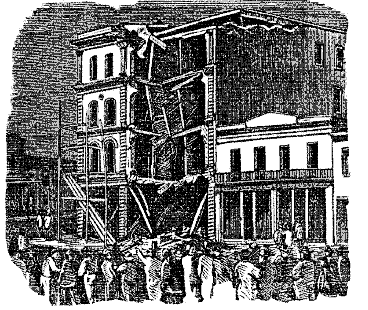
Experienced a very severe earthquake – in fact the most severe ever felt on this coast. Houses knocked down, windows and walls smashed and cracked, even the great bell of the City Hall was tolled by the vibration of the tower. Quite a panic was created throughout the whole of the State.
Nov 3rd 1865
 |
| Henry John Temple, 3rd Viscount Palmerston (1784-1865) British Prime Minister, 1858-1865 and 1859-1865 |
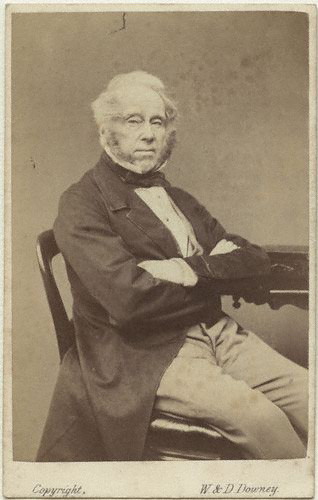
News of the death of Lord Palmerston reached California. Immediately every English house in the city put the British Ensign at half mast.
Nov 8th 1865
Left the U.S. Rest
Nov 9th 1865
Saw Miss Emily Thorne of the Theatre Royal, Manchester, at the Academy of Music in “Unequal Match”.
Nov 13th 1865
Took passage with Harper and Brashears31 in the Barque “Harminia”32, Captain Shoemaker for Valparaíso, near Santiago, Chile.
Nov 15th 1865
Sailed at noon
Dec 15th 1865
Crossed the Equator
Dec 17th 1865
 |
| Porpoise (porcus marinus) (Marine mammals of the north-western coast of North America) |
One of our passengers, Mr Hudson, harpooned a large porpoise and the next morning had breakfast of it and a very palatable dish it was.
Dec 24th 1865 – Christmas Eve
Another Christmas from home, and at sea too – though under the circumstances we did very well. The Captain supplied all hands with a good glass of whiskey punch each – one of the cabin passengers (the Count as we called him) – had a dozen Chinese lanterns and, as we were laying becalmed, we hung them up amidships. We had some good banjo playing by Mr Josh Mintary and, as the passengers numbered about 60, we managed to have a pretty good time. “John Brown”, “Marching through Georgia”, “Just before the Battle Mother”, “When Johnny comes marching home” and other popular American songs had each a turn in the evening’s entertainment and, had King Neptune been in the immediate neighbourhood of our vessel at the time he would in all probability have joined us and said we were the jolliest ship’s company that ever crossed his path on a Christmas Eve.
Dec 25th 1865
This has been emphatically a “Feast day” with us. Our usual bill of fare was rice or mush – with coffee for breakfast – salt beef and potatoes for dinner and hash and tea for supper. Today we had a good dose of fresh pork, cake and pie each.
Dec 31st 1865
As we were lying becalmed today a large shark with his pilot fish was seen playing round the stern of the ship. Mr Hudson got his harpoon at once and threw it into the very heart of the great brute. With some difficulty we hoisted him on deck and found he measured 6 ft 4 in long. We were all astonished at the extraordinary tenacity of life the creature possessed for, after being disembowelled and “curtailed” he exhibited signs of a evident desire to return to his native element. After his head was cut off – and though it seems incredible – whilst the process of cutting out his backbone was going on he made one final effort that sent the position of his carcase (possessing the most life) several feet along the deck.
At midnight, as usual on passenger ships at sea on New Year’s Eve, we had a great noise. Every article in the ship capable of being turned into an instrument of discord, from the Captain’s speaking trumpet to the cook’s frying pan was brought into requisition to bid farewell to the old year. And, when we retired to bed, two hours of the New Year had passed over our heads.
Jan 1st 1866
Another shark hove33 in sight today. Wishing to try my hand with the harpoon, I persuaded Mr Hudson to let me have a trial at the brute. So I threw it and sent the head of the iron right through the body of the shark. After hauling him on deck we were rather astonished to find in his “bread basket” two wind pipes and the lights from two sheep killed aboard yesterday as well as a pair of old shoes thrown overboard by one of the crew this morning. All [were] in a state of indigestion and perfectly recognizable. I saved a portion of his backbone.
Jan 27th 1866
 (Chile Ilustrado, Recaredo Santos Tornero) |
Sighted land at 8am and anchored in the Bay of Tomé at 1pm in Chile 7 miles from Talcahauno. Soon after our arrival the customs house officers came aboard and, on being informed that we were bound for Valparaíso the adjacent port, they told our Captain that the Spanish fleet was then blockading the place. Consequentially we should not attempt to enter. This was what we could expect as the news of the declaration of war between Spain and Chile had reached California two days before our sailing.
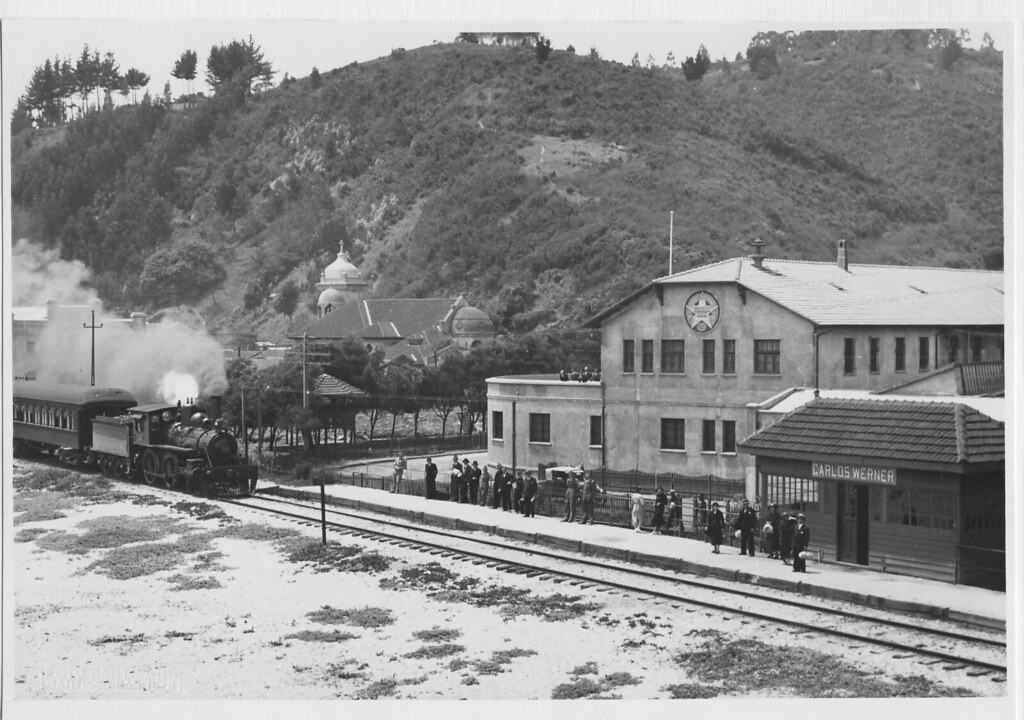 |
La estación Carlos Werner, Tomé in 1916 (conce_antiguo, Flickr)
|
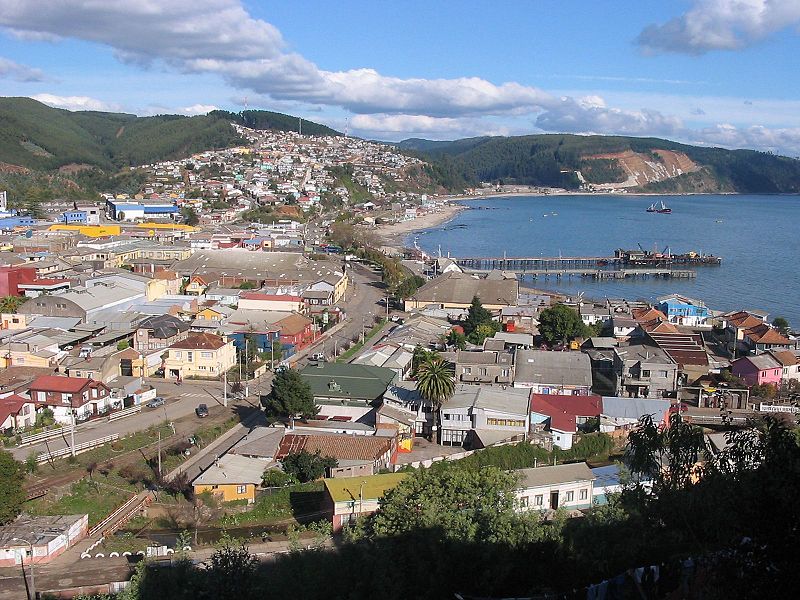 |
| Tomé, 2007 (Nellorolleri, Wikimedia) |
The Captain decided to discharge the passengers in Tomé. Although very much discouraged at the prospect before us we went ashore and found a miserable little one-horse town composed of a number of one-story mud buildings with about a dozen of its inhabitants able to speak English. There are no wharves here for the vessels to haul alongside of. All the cargoes are conveyed to and from the ships in large launches pulled by the native labourers called peones. We found 12 vessels in the bay, 9 of which were under the English Flag.
 |
| A Carreto ( Santa Ana Public Library) |
The ox-teams, of which there are a goodly number, were objects of amusement as well as annoyance to us. The carts, or as they call them Carretos are composed of branches of trees tied together with native grass. The wheels are round pieces of wood – probably sections of trees. The axles are also of wood. So much wood, and such an amount of friction, requires grease – but these people discard its use totally. They prefer the wretched noise of the screeching. This is one of their many peculiar whims. They love to be, in many respects, contrary to the Gringos (as they call all foreigners) yet, in their manner of dress when not working, they do their best to imitate them.
 |
| A Chilean Ox-team with driver on board (H Willis Baxley, 1865) |
The driver of the above-mentioned singular vehicles walks ahead of his oxen with a long wand or stick and administers continual chastisement.
Jan 30th 1866
 |
| Portales de la plaza, Concepcion, in the 1860s (Chile ilustrado, Recaredo Santos Tornero) |
Hearing of some gold mines situated about two miles from Tomé, Harper and I decided to try them. Accordingly we took the stage to Concepción – a distance of 21 miles. This was really a delightful ride – saving only the dust. The scenery on every side was most magnificent from sea shore to fearful precipices (caused by earthquakes which are very common in this country). Thence to some little settlement – through groves of trees up hill and down hill.
 |
| The old cathedral in Concepcion – destroyed by an earthquake in 1910(Wikimedia) |
Arrived at 2.30pm and found quite an extensive city containing some 12,000 inhabitants and quite a number of large, respectable-looking buildings. The cathedral is indeed a fine specimen of architecture and the interior is splendidly decorated. The Plaza, containing a very beautiful iron fountain, is a great ornament to the city and is much used by the inhabitants as a resort for evening promenading.
I also visited several other churches and was much astonished at their appearance. The natives are without exception Roman Catholics. Though they all profess the faith, they are most inconsistent in their daily life and dealings.
The interiors of these churches are very handsomely decorated. The altars are composed of workmanship of the costliest description and every one contains a wax image of the Virgin Mary. These dolls are beautifully attired – some in silks, some in satins – but all wear crinoline or something that answers the same purpose. The majority of them wear earrings, brooches and even rings on their fingers.
There are no seats in the churches the poor deluded devotees kneel on a cold stone floor during the whole service.The ladies of the country, when going to church, carry a handsomely embroidered cloth whereon to kneel.
We staid at the Hotel de Commercis34 kept by a Mr Derbyshire, a Manchester man.
Jan 31st 1866
 |
| Coronel, Chile (memoriachilena, date unknown) |
Left Concepción at 11.00am on the Stage for Coronel en route for the mines. Crossed the river Biobío in small launches. This, which is the largest river in Chile, has its source at the Andes.
At Bodega35 we were joined by Mr and Mrs Wright from London. Mr Wright is a man who has been travelling in Chile for some years as a photographic artist. He is a man of considerable intelligence and gave us a great deal of useful information concerning the Country. This proved of some service to us. On our arrival at Coronel they invited us, during our stay, to make our home with them. As we only intended staying one night, we accepted the kind invitation.
 |
| The area around Concepcion based on a map by Lebour & Mundle The map appeared in an 1870 article about coal-bearing rocks. |
This is another small Spanish town – a very miserable little place containing not one building of any other materials than wood and a number of native huts formed of very rough branches of trees roofed with grass.
The natives in these rude habitations are quite content without any article of furniture. The floor is their squatting ground and their bed. In the centre of the hut they build a small wood fire and do all their cooking by it.
In civilization the lower classes in around the small towns are not, I consider, one iota superior to the Chinook Indians of Vancouver Island and Puget Sound.
Feb 1st 1866
 |
The port of Lota in the 1860s
[Chile ilustrado, Recaredo Santos Tornero]
|
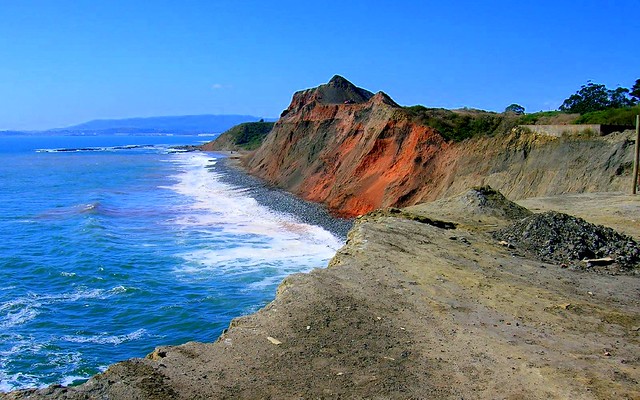 |
| A former mine and tiera colorado in Lota, Chile, (Rene Robles, Flickr) |
Five of us, viz Harper, Brashears, Heinmann, Bauer and myself, shouldered our blankets and started for the expected Eldorado – afoot in right good earnest – and the same evening arrived in Lota, another small town, but possessing some good lucrative coal mines and a very extensive copper ore refinery. A very considerable quantity of the ore from this place is shipped to England – principally to Swansea.
Staid at the house of Mrs George Lee – a Chilean Señora married to an American. Here we were very well treated at a moderate charge.
Feb 2nd 1866
Started again at 5am and after a very rough walk of over 30 miles, we arrived at a small native ranch – more than eight miles from any other human habitation.
Here we found the Señor, his wife and children. I was chosen as interpreter, though my knowledge of Spanish was very limited indeed. I was likely to remember however my first attempt at a sentence. It was this: “Buenos dias Señor, cinquo36 hombres, muchos hambre, caro pan y queso en jueves tambien” which, being literally translated into English, is simply this: “Good day sir, five men very hungry want bread and cheese or eggs”.
 |
| Henry Taylor's Journal – preparing a meal in Región del Biobío |
We could get neither bread not cheese, but the Señora, noticing I presume, that our faces betrayed our hunger, pointed to some chickens. We did not need any further pressing, but one of the party felled six of the young hens. Whilst some went to kindle a fire the rest of us strolled onto the patch of ground the worthy Señor cultivated and were most agreeably surprised to find growing plenty of potatoes and onions. We gathered what we thought would be sufficient for a good mess, and as we had a professional cook with us (my old friend Brashears) we soon had a good supper under way. After partaking of the same, and smoking a pipe, we began to look round for a place to sleep but, as the house (if it may so be called) only contained one apartment and we had already seen nine of the family, we decided to sleep outside. Rolling ourselves up in our blankets, tired, weary and footsore, we soon fell asleep – but not for a very long period as the fleas and mosquitoes were so numerous. The most weary of us could not get a wink of sleep.
For an hour or so we stood it like heroes, but patience is only human. We, as a last resort, got up, made a good large fire and resolved to trust to the smoke emanating from that, and our tobacco pipes, to keep the enemy off. We succeeded to some extent but, with the mosquitoes, some were smart enough to stow themselves in our clothing and blankets, where our attempt to drive them away had no effect whatever.
However, nature had to give way at last and we slumbered, perhaps for fifteen or twenty minutes. Then the clouds, which had been looking rather gloomy the whole evening, poured down upon us such a deluge as to wet our blankets through in a very short time. All we could do was to grin and bear it as we had no available place of shelter.
Early in the morning, our host was astir and getting ready a repetition of the previous evening’s supper. We ate it and off we started again but, on account of the slippery state of the ground, we were unable to get along as well as before the rain.
 |
| Chilean miners in 1855 (Jay Monaghan) |
About noon we got a horse each and rode the rest of the day and the whole of the following day before we arrived at the Romars37 – the mining settlement of our destination which was called “Los Minos de los Noches”38 or “The Mines of the Night”.
Here we met with several old Californian miners, doing a little here and there, but they told us we would in all probability be disappointed as there was only one company on the creek (Pas Diablo)39 making more than grub. At this intelligence our ardour was somewhat damped – but we determined on a trial.
We passed the night in a miserable brush shanty – with any quantity of fleas and mosquitoes for company.
Feb 4th 1866
Four of us walked over to the creek this morning and inspected several of the working claims. We also, by permission of the owners, panned out several pans on the various claims but the results were anything but encouraging.
Feb 5th 1866
Early in the morning Harper and Heinmann set out for Arowco40 to purchase tools and some little necessaries we could not procure at the Romars.
Feb 6th 1866
Commenced work on the Big River41 but, after damming the stream, setting up sluice boxes and in fact working like niggers for eight days, we decided to give up as we had only taken about 20 cents worth of gold in the whole time.
Feb 15th 1866
Harper, Brashears and myself started back afoot, very much discouraged and very low in pocket. This evening we “camped out” as we were too tired to proceed any further, though we knew there was a ranch about five miles on. We slept better than usual and, next morning at about 6 o’clock we had the satisfaction of seeing smoke issuing above the trees on the lower side of the hill we were crossing. We staid awhile and made hearty breakfast off bread and cheese and again pursued our journey. It was indeed weary work – all our path lay through very thick woods up and down hill. The days were very hot indeed and the streams from which we quenched our thirst “few and far between”. We did occasionally meet a Señor on horseback and we were glad to return his greeting. We were not inquisitive enough to enquire his destination though we had many surmises as to where any Christian (except ourselves of course) could possibly be going.
Feb 17th 1866
In the evening we arrived at Lota again and staid at a native “Casa de Trata” [House of Slaves].
Feb 24th 1866
After having spent a week here, endeavouring by every exertion to obtain some kind of employment, I heard of a vessel going to Coquimbo and asked the Captain for a chance to work my passage. The ship was lying at Coronel so I walked over and the same evening I had the pleasure of stepping aboard the fine American ship “Duchesse de Orleans”42.
Feb 26th 1866
 (Chile ilustrado, Recaredo Santos Tornero) |
Sailed at 10am and after a passage of five days arrived at Coquimbo, a distance of 480 miles from Coronel. During the passage, of course, I stood my watch night and day. Never can I forget those weary two hours of a “lookout” on the topgallant forecastle [the uppermost exposed deck above the forecastle] and what numerous reflections would fill my brain. I cursed my folly for leaving a good berth in California to go to a country of whose manners, customs, people or climate I knew nothing. Above every other regret stood predominant my cursed folly at home in being so unsettled and in cultivating my wondering disposition instead of checking it. I know of no one so much to blame as myself. I have been my “greatest enemy”. I had always at home an opportunity of being at least in a respectable position, both as to business and society. But, since leaving England, I have been obliged to take menial situations and never been recognized by any person in a superior position to myself. The same evening of our arrival at Coquimbo I went ashore and staid at Philip’s Boarding House.
March 5th 1866
 |
| Coquimbo Bay in 2006 |
Went aboard the Pacific Steam Navigation Company’s Steam Ship “San Carlos”43 and obtained employment. Sailed the same day and called at the following ports:
| March | 9 | Papudo | Chile | ||
| " | 9 | Tongoy | " | ||
| " | 12 | Coquimbo | " | ||
| " | 13 | Huasco | " | ||
| " | 13 | Caldera | " | ||
| " | 13 | Carrizal | " | ||
| " | 14 | Chanara | " | ||
| " | 17 | Iquique | " | ||
| " | 17 | Mejillones | " | ||
| " | 17 | Pisajua | Bolivia44 | ||
| " | 18 | Arica | " | ||
| " | 18 | Ilo | " | ||
| " | 19 | Islay | " | ||
| " | 20 | Chala | " | ||
| " | 21 | Pisco | Peru | ||
| " | 21 | Chinchahalaos | " | ||
| " | 22 | Callao | " |
Walked over to the copper mines of the English Company at Guacan45 where I found quite a Welsh settlement. I enquired if there was any chance of employment in any capacity whatever and was answered in the negative. The probability is that, had I been Welsh instead of English, I would have obtained employment.
March 9th 1866
At most of these ports I went ashore with the storekeeper – but what I saw is not worth mention. The majority of ports in Chile are supported by copper and saltpetre mines. In Bolivia how and by what they exist, goodness only knows. In the Peruvian ports the natives cultivate fruit and manufacture wine and pisco [national drink of Chile and Peru]. The profits on the two latter articles are considerable as the demand in Callao is very large.
March 30th 1866, Good Friday
This is the first time I have seen this day noticed since the last one I spent at home. As this is a Catholic country the people make a great deal of the day.; They have processions through the streets and services in the churches.
 |
| There are still street processions in Peru as seen in Miroflores, near Lima, on 11 November, 2006 – St Martin's Day |
 |
| The yards of square-rigged sailing ships were often cockbilled as an act of mourning. Geoff Hunt drew this sketch of HMS Surprise – yards cockbilled – in memory of Patrick O'Brian |
The vessels lying in the harbour hailing from Catholic countries all have their yards “cock-built”46 from Thursday sunset to Saturday sunrise.
April 8th 1866
Taken sick and the Company’s Doctor sent for to see me. On feeling my pulse and hearing of my symptoms he told me I had fever and ordered me at once to the Lima Hospital47. Here the doctors told me I was suffering from Typhus fever. I was insensible for about a week. Immediately on recovering my consciousness I sent for the Lady Superior (bye the bye, the hospital is in the charge of the French Sisters of Mercy48) and requested her to write a few lines to my Mother and tell her of my position. This she did with an evident degree of pleasure as she saw it would gratify me. She is a very fine woman, the widow of a French count of some note who perished in the Crimean War. She told me she had travelled a good deal in England and spent several months in Manchester and Salford.
 |
| A courtyard in Hospital San André, Lima (Photograph by Santiago Stucchi Portocarreroy) |
[Santiago has written a History of Hospital San André including superb photographs]
 |
| Hospital San Bartomolé, Lima (Wikimedia) |
April 28th 1866
The wife of the President of Peru visited the Hospital today and presented every patient (about 850) with one real [a 25-cent Peruvian coin] each.
May 2nd 48 1866
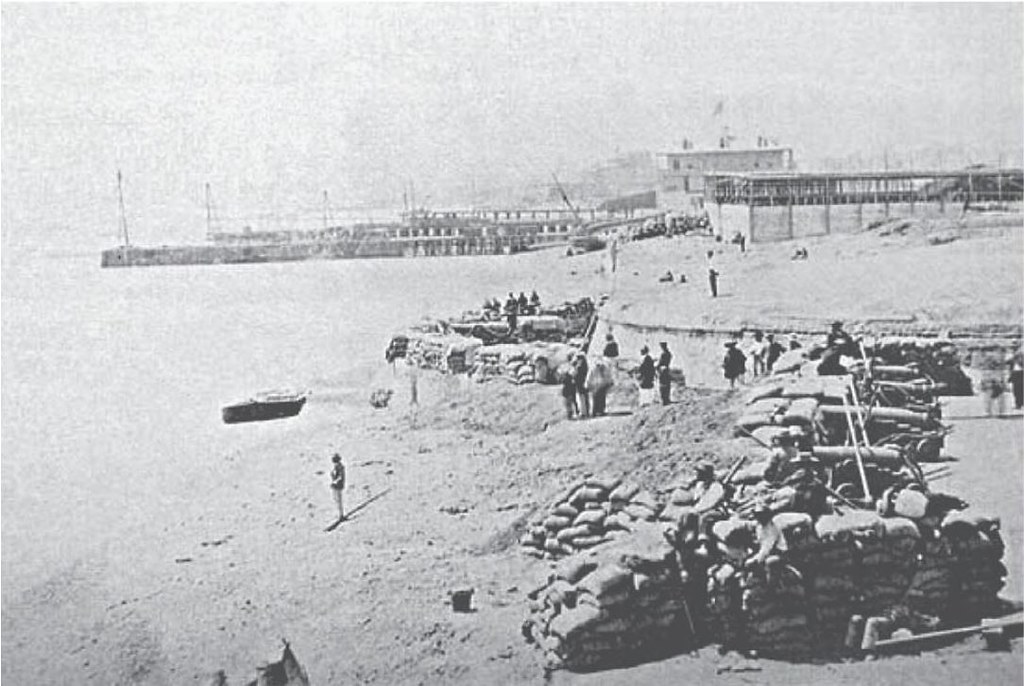 |
| Preparing defences at Callao in anticipation of bombardment by the Spanish fleet. This photograph would have been taken about five weeks after Henry Taylor landed there on 22 March 1866. (Photograh from Museo Naval del Perú) |
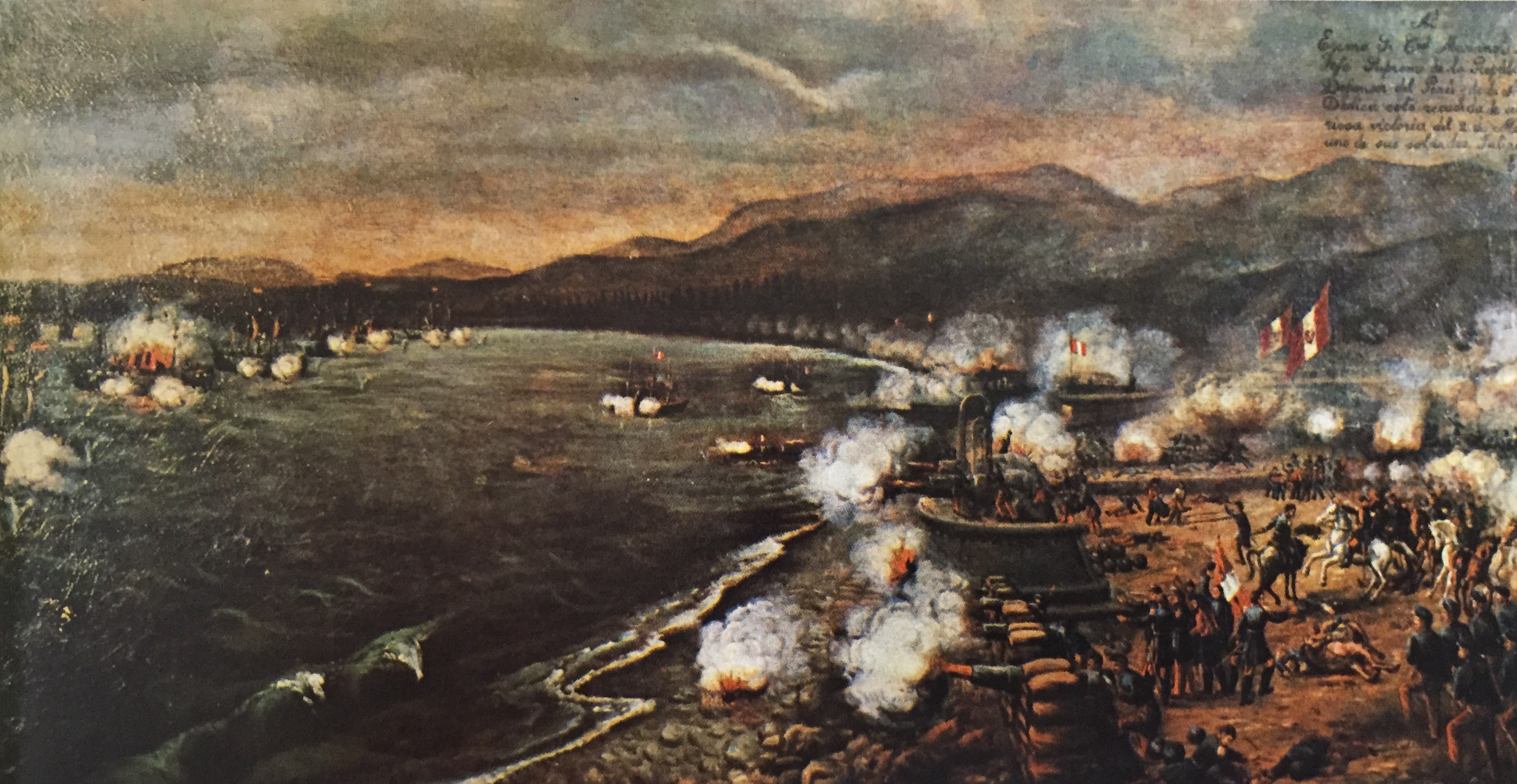 |
Callao, 2 May 1866 (Wikipedia español)
|
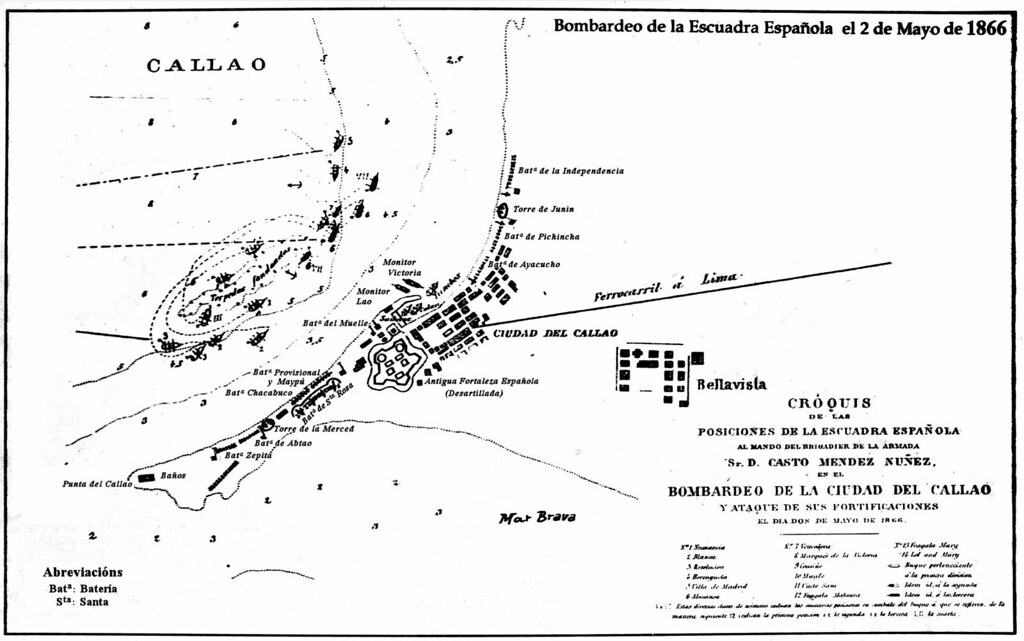
|
| The ironclad Numancia, flagship of the Spanish fleet (Wikimedia) |
The Spaniards have been threatening to bombard the principal ports of Chile and Peru for some time past and today they are carrying out their threat as far as Callao is concerned. We can hear every gun and are wondering whether or not they will be successful in destroying the town. I myself am feeling rather uneasy as I left my personal property at my Boarding House there not anticipating an attack so soon as this.
May 4th 1866
We have now 32 of the sufferers from Callao in our ward. The majority of them were injured by a large bombshell thrown by the Spanish Admiral's ship onto the beach near Santa Rosa Battery. The place is covered with small stones weighing from an ounce to two pounds each. The effects were fearful, proving in many cases instantly fatal.
Two of the poor fellows died here this morning close in sight of the bed where I lay. It has been necessary to amputate the limbs of some of them. Only this morning I was witness of the operation being performed on two poor soldiers, mortification having threatened their legs.
May 5th 1866
Two more carried to their last home today, one from the very next bed to my own – making the fourth who has died on it during my short stay here.
May 7th 1866
The Doctor pronounced me sufficiently recovered this morning to leave the hospital and, strange as it may appear, I was reluctant to go. The scenes daily witnessed by every patient in that charitable and truly noble institution are repugnant to the feelings of the most hardened and inhuman. Yet one gets accustomed to it, and when one leaves, one is sure to miss the morning and evening visits of the “Madre” [mother or matron] and her shrill monotonous voice repeating the threadbare prayer in Spanish.
 |
| Lima Cathedral, c1865 (Mánuel A Fuentes) |
 |
| Lima Cathedral, 2006 |
During the afternoon (though feeling anything but well enough to walk much) I had an opportunity of seeing the far-famed cathedral and churches of Lima. The former is built in the Plaza or Public Square and it is, without exception, the grandest and most imposing edifice used for religious purposes that I have ever seen – not excepting by any means St Paul’s in London.
 |
| Iglesia San Francisco, Lima c1865 (Mánuel A Fuentes) |
 |
| Iglesia San Francisco, Lima in 2006 |
The churches are numerous and built in a stout, substantial manner but, at the same time, in a very fanastical shape and style. The bells of some of these places are tolling incessantly from sunrise to sunset.
 |
| Calle de Los Judios Lima c1865 (Mánuel A Fuentes) |
The city is in itself a goodly-sized one and a great commercial depot for the whole of the Peruvian and Chilean coast.
I left Lima by the evening train for Callao and, on my arrival there, found the town in a state of great commotion. Only a few stores are open and all the movable goods and merchandise have been removed from them to places beyond gunshot – chiefly to Buena Vista, a small village on the road to Lima. The Spanish fleet, having met with a warmer reception than they anticipated, after 4½ hours hard shooting, retired to the entrance of the bay, there to repair damages. At the time of my return to Callao a renewal of the attack was expected every hour. The town bears evidence, in a very substantial manner, of a recent bombardment. The largest and principal buildings are all more or less damaged but, as the majority of the houses are built of mud or light wooden framework, the shell and shot passed through them as a pistol ball would through stiff paper leaving only an aperture the size of the missile itself.
Most of the inhabitants, I find, have gone aboard the vessels lying in the bay, there to await the end of the hostilities. What few people were left in town were kept in a dreadful state of suspense until. . .
May 9th 1866
. . .when the Spanish Squadron withdrew and the various foreign consuls at once notified the public that the blockade was rased. In a few days the town resumed its former business aspect, but the hostile encounter had produced stagnation amongst the tradesmen and people of business generally, from which it will take some time to recover.
The general opinion here seems to be that the Spaniards did not consider their squadron of sufficient size and force to meat [he means mete] out to the Peruvians a most disgraceful chastisement, so the Admiral had decided to retire for a while to recruit [archaic for recover] his strength.
Callao
 |
| A Peruvian iron-clad ship in the floating dock at Callao (Illustrated London News, Jan 1867) |
The principal seaport of Peru is not so large or thickly-populated as Lima (though being far superior as a business town) nor can it boast of such handsome buildings as that place.
The Railway Station is a long, plain-looking, two-story building situated on the Mold (as the pier is called). The Railway Company is English as also are most of the employees.
The police are all natives. They wear a sort of military surtout [a close-fitting overcoat] in style somewhat resembling the tunic of dark cloth worn by the Third Manchester Volunteers. They each carry a small carbine which they frequently use without proper discretion. They are of a very bold and courageous disposition, as may be inferred from the fact that they generally combine to the number of five or six to take into custody a single person.
A soldier of the 3rd Manchester
Volunteers in Henry's time
The laws of the country are of a most despotic nature, most especially so in regard to the treatment of Foreign Subjects. A man being arrested on mere suspicion (often at the request of some individual who has a “crow to pluck” with him) is kept under the strictest surveillance in Castel Marta – sometimes for months without being allowed the privilege of an interview with friends, relatives or a legal advisor. When the trial does take place he is neither allowed to be present, nor is he made acquainted with the result thereof for weeks. Money will invariably purchase the freedom of the greatest rascals in the country.
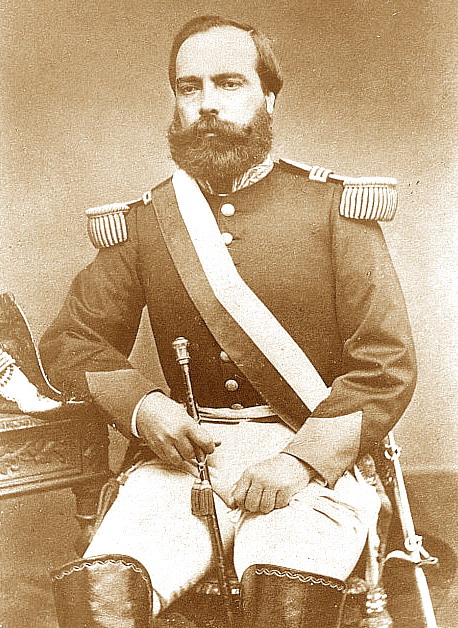 |
| Mariano Ignacio Prado |
The president – Señor Prado49 – is the choice of the Revolutionists of the Fall of 65 and is generally regarded by both the native and foreign inhabitants as the Saviour of Peru.
His policy is of a very energetic nature and has already added much to the commercial resources of the Republic.
The "Compania de Vapors Ingles"50 or "English Company of Steamers" is by far the largest and most important business institution here. They have some 18 to 20 fine steamers – both side-wheel [paddle steamer] and propellers – constantly running between Chile, Peru and Panama. They call at nearly every intermediate port. They have a large establishment at Callao, occupying some acres of ground. Here all the work necessary for carrying on so important and extensive a traffic is executed. Almost every trade has its representative.
The Army of Peru
This resembles to a great extent that of Chile. The soldiers are hungry-looking, dirty, miserable, ignorant and slovenly to a most incredible extent. To see them on an afternoon’s parade you would take them to be the remnants of a starved-out garrison. Their uniforms (if such they may be called) are manufactured from the commonest materials possible and made up without regard to shape or fashion. Withal they ape the manners and airs of their military brethren of more civilized countries and endeavour by every little means to appear gaudy and to make as great a display of jewellery as their limited pay will permit.
 |
| A Peruvian soldier and his wife (Library of Congess) |
It is no uncommon sight to see a private with toes peeping out of his dilapidated shoes, his chin dirty from neglect of proper and periodical use of the razor and his hair exhibiting unmistakable evidence of long estrangement from the comb. He may well sport a fancy chain of gilt brass and a “Birmingham gold” ring on his finger.
These arduous devotees to Mars are nearly all married, though they are not permitted to reside with their wives, either in or out of quarters. When the men are in barracks it is quite a sight at meal times to see two or three hundred wives squatting on the waste piece of ground outside the gates preparing the “Savoury” dishes for their “Lords and masters”. Some of the men spend their whole pay (which amounts to about twenty cents, or ninepence, a day) on their stomachs leaving their better halves to procure their own necessaries as best they can – often at the cost of compromising their honour and violating their solemn marriage vows.
During my stay in this “great and mighty” republic I have not seen more than two natives who have reached the age of three score years. It is a fact worthy of notice that the majority of these people die between the ages of twenty and thirty. Whether or not this is owing to the climate (which is a very pleasant one having no winter), to the lazy lives the people lead or to the large quantity of bad spirits they consume in a lifetime, who can tell? They are in general an idle, drunken, gambling, worthless race and seem incapable of any instinct beyond that of satisfying their morbid appetites.
 |
| Veiled ladies of Lima (Jay Monaghan) |
The ladies of Peru are really specimens of great beauty. I do not suppose any other country in the World (excepting perhaps Spain) contains more handsome brunettes. They none of them wear bonnets or hats, either in their dwelling or when walking or riding out. Generally their outdoor costume is a handsome, expensive and well-fitting dress of black silk or satin (usually the former). A large shawl of the same colour, edged with fine silk lace, often interwoven with beads, envelopes the upper part of their body leaving only the eyes and nose visible. It is difficult to recognize a lady a second time after seeing her in this costume.
The streets of Callao are very narrow and dirty and are filled with long rows of one or two story houses. No open ground is ever left between them.
The inhabitants are supplied with water for culinary and other purposes by Negroes and Chinamen who hawk it by the barrel on the backs of thoroughly domesticated Jerusalem ponies.
The town is lighted by camphene or coal-oil lamps placed at intervals along the streets in glass casements similar to those used in lampposts in England.
The Peruvian authorities have a mode of treating their criminals and prisoners generally which would I think, if adopted in England, have a very beneficial effect on that class of the community whom it would be most likely to affect. They march them through the principal streets of the town twice a day on their way to and from their labours at the Alameda51.
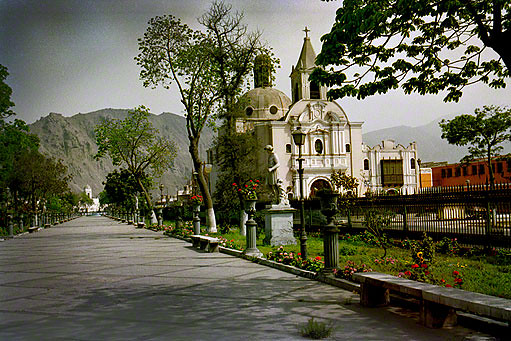 |
| The Alameda, Lima (Flickr, Armando Huaylinos Hermoza) |
In these “open air exercises” the prisoners are escorted by a long file of armed soldiers walking in procession on each side of them. Thus any attempt to escape would prove futile. The miscreants naturally hang down their heads being ashamed to gaze on the countenances of their better-behaved fellow beings.
Fruit of every description abounds in the Country and is consequently sold at a low price. Pineapples, pomegranates, figs, dates, grapes, oranges, limes, quinces, pears, apples, plums, strawberries, peaches and cherries each have their season and are exposed in large quantities in the public “plaza” or market place.
Sunday is the great holiday of all Spanish and Spanish-American people and here it is no exception. The people may be seen gaily dressed out in their best, going to prayers in the early morning or, in the afternoon, enjoying themselves horse-racing, gambling and bull-fighting and, in the evening, at the theatre. The vendors of refreshments, liquors and cigars all depend on having as much business on the Sabbath as in the six previous days put together – and this is generally the case.
Sunday is also “Liberty Day” for the sailors belonging to the naval & merchant vessels lying in port and many a hard-earned dollar Jack leaves in the town and finds nothing for it in the next morning but a racking headache and a strong disinclination to resume his monotonous line of duty aboard ship.
 |
| A Fandango c 1865 – possibly in Peru (Georg Westermann Verlag) |
I had on one occasion an opportunity of being present at a “Fandango” or Spanish ball given in honour of the departure of the Spanish squadron. The hall was spacious and brilliantly illuminated. The walls were tastefully decorated. Instead of a numerous orchestra of brass instruments the company danced to the music of a violin and several guitars, this latter instrument being the favourite of the country. I was somewhat interested in the execution of a native dance called a “Quaker”. A number of señor and señoritas sat in a circle round the dancing party, clapping their hands to the time of the music and humming a song in a very doleful strain. I was greatly disappointed in the dancing of the ladies. I expected to see a great display of ability and grace in their movements. They stood upright, their hands down by their sides and their eyes fixed on the ground before them and sliding about without any perceptible means of motion, for their feet were invisible and the hem of their dresses forming a perfect circle around them, reaching to the ground.
They looked as grave as though they were going through some religious ceremony, their faces as little exited as their limbs and on the whole, instead of the spirited fascinating dances I had expected, I found the “Fandango” on the part of the women at best a very lifeless affair.
The men did better. They danced with much grace and spirit, moving in circles round their nearly stationary partners and showed their well-attired figures to great advantage.
 |
| Boy on horse (Wikimedia) |
The Peruvians, like the Spanish from whom they are descended, are very splendid and accomplished equestrians. There are probably no better riders in the World. They get upon a horse when only four or five years old, their little legs too short by half for the animals’ sides. They may be said to keep on them ‘till they grow to him.
The stirrups are boxed up in front to keep the feet free from underbrush when riding through the woods. The saddles are large and heavy, strapped very tight to the animal’s back, and have large pommels in front round which the rider coils his “lasso” when not in use.
When they wish to show their activity, they make no use of the stirrups in mounting, but strike the horse, spring into the saddle as he starts and, sticking their spurs into him, are off on full gallop. These spurs are cruel instruments of torture. They have four or five rowels [spiked revolving discs at the end of a spur] each about an inch in length, dull and rusty.
During my short stay in Callao, I was much pleased to get the loan of a Manchester Weekly Examiner and Times. I had not seen a paper from home for many months so that this one was especially welcome. No one has ever been in a distant country, long absent from home, who cannot understand the delight that is caused by the perusal of a newspaper from one’s own native place. Nothing carries you to a place or makes you feel so perfectly at home.
 |
| An 1857 advertisement for the Manchester Weekly Examiner and Times |
I read every part of it: “Sales by Auction”, “Cheap Trips”, “Houses to Let”, “Clerks &co Wanted”, “Apartments to Let” and “Lost, Stolen or Strayed”. Unconsciously I found myself at home in Cheetham Street, reading the same paper by a cheerful hearth. I went, in mind, to Blackpool, Southport and Lytham. I enjoyed the sea breezes and the evening promenade. I heard the Blackpool Band discoursing their miserable strains. Then I saw the puppet show at the Claremont Hotel.
I rambled on the cliffs again and ate oatmeal cakes in the glen. And when I had recovered from my daydream I found myself in a strange and, to my feelings, uncongenial country, sick, destitute and miserable, longing for an opportunity to recall the last years of my wasted life and to be again placed in the Country House in Portland Street with the benefit of good example and precept. Oh! What a different life it should be!; And yet how vain these reminiscences and these determinations! The drunkard resolves to drink no more. The thief resolves to become honest. But then how easily over and away to the winds go their resolutions.
May 30th 1866
Shipped as Steward of the British Barque “Delhi” of Liverpool with Mr J Doyle the Master to go to the Chincha Islands [150 km south of Lima] and load guano52 for England. Went aboard and commenced work.
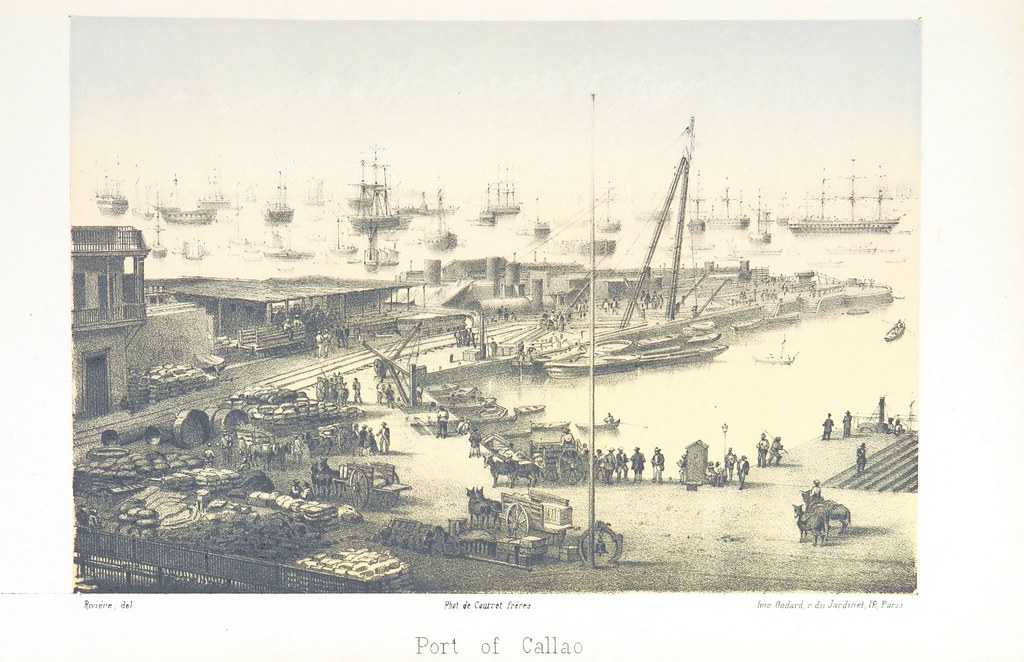 |
| The Harbour at Callao, c1866 (uploaded to Flickr by The British Library) |
Laid in Callao Harbour discharging cargo and receiving ballast till [stiff clay containing boulders, sand etc].
June 20th 1866
We lie in a long line of ships and every Sunday it is astonishing to see how many nations are represented here. In the same line as ourselves I can see American, Bremen, Hamburg, Dutch, Swedish, French, English, Chilean, Peruvian, Portuguese and Italian Ensigns at the various peaks.
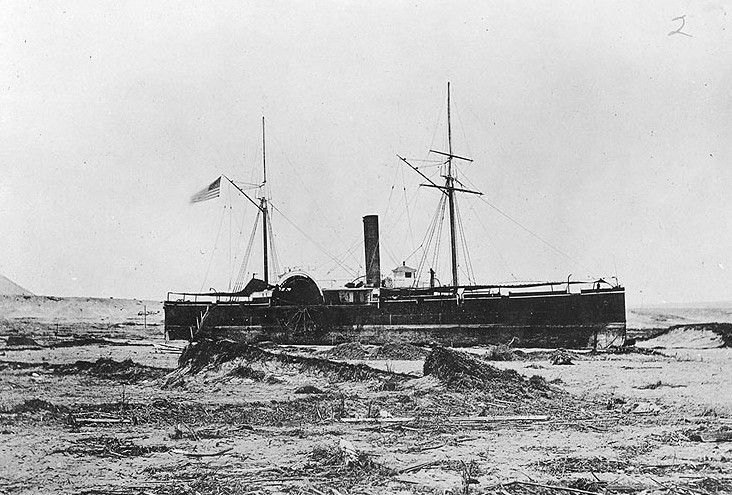 |
| A couple of years after Henry sighted her in Callao "Wateree" came to a watery end! (Wikimedia) |
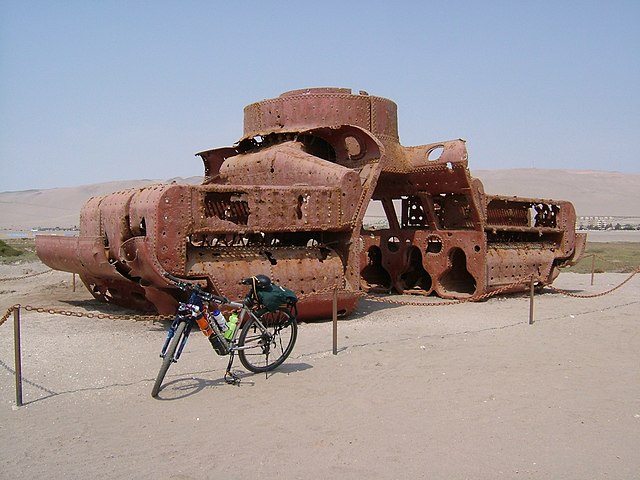
| The remains of the Wateree's boilers on the shore north of Arica (Wikimedia) |
This being Her Majesty’s Coronation day, the British men of war “Leander”, “Topaze” and “Mutine” and the US gunboats “Wateree”, “Powhattan”, “Suanee” and “Nyack” fired simultaneously a royal salute at noon.
June 20th 1866, 4pm
Got under way during which I fell down the main hold onto some old barrels and severely hurt my back & side. I had to lay up for four days.
June 27th 1866
After seven days of head winds and calms we arrived and anchored off the North Island and next morning we were towed up to the middle Island Channel We moored the ship, unbent the sails and made preparation for 65 laying days.
July 4th 1866
This is the “Great and Glorious Fourth”, the day of all days with Americans. There are a good many US vessels lying here at present and the captains have got up a regatta today. There was some good sport but, had the English captains withheld their support and patronage, the affair would have been a very consumptive one indeed. Nearly every vessel in the port displayed every available inch of bunting.
The Chincha Islands
 |
| The Chincha Islands, 1863 (Wikimedia) |
These are three in number situated about 15 miles South of Callao. They are rapidly gaining popularity as a good and profitable rendezvous for vessels requiring cargoes for Europe. The article being exported from this place is guano (or as it is spelt in Spanish, “Huano”) and contains a very large amount of Ammonia. Consequently the odour arising from it is strong and anything but agreeable to the nasal organs of Europeans generally.
The company who at present hold and work the Islands employ a great number of Chinese coolies imported expressly for the purpose. The guano is cut and wheeled by these men down to the heads of the various shoots under which launches carrying from 5 to 15 tons each are made fast to receive loads. The launch, which is generally in the charge of a “Launchero” [latin-American word for the driver of a small boat] is then taken alongside the vessel from which it hails. The cargo is then taken aboard ship in tubs hoisted by means of horses. Nearly every vessel that comes hires one of these quadrupeds. They are well-trained, hard-working animals and seem to me to understand both Spanish and English thoroughly.
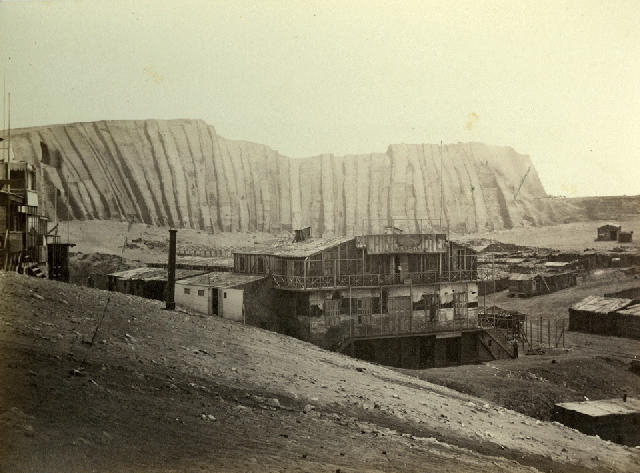 |
| Mining guano in the Chincha Islands (New Bedford Whaling Museum) |
I went ashore on the South Island one afternoon and picked up several eggs and a few sculls – the latter probably belonged to either sea lions or seals as these creatures abound in large numbers all round the islands.
During my stay here I was often amused at the gambols of the seals. They catch and eat a fish called a mullet which is very plentiful here. But the seal does not seem to be able thoroughly to digest a whole fish at once. In order to render it more convenient he holds the head in his mouth and, coming to the surface of the water, shakes his head violently and thus breaks the fish into a number of smaller pieces. Any number of small birds are constantly hovering around on the lookout for a seal at breakfast. When the operation commences they poise over his head and watch where the fragments of fish fly to. From them they make a hearty breakfast themselves. As soon as the meal is finished, his sealship amuses himself by rolling about as near the surface as possible and basking in the sunshine.
When a vessel has completed her loading, the crew gather together on the forecastle and give three hearty cheers for their own ship – and occasionally one or two for their neighbours if the Captain and officers happen to be popular.
In the evening the forward part of the ship is suddenly illuminated as eight bells are struck. From the poop blue lights and lockets are freely issued.
Invariably, on the occasion of a vessel leaving port, the Captain gives a party and everyone in the harbour who claims the slightest acquaintance with him considers himself fully justified in participating in the repast.
During our stay here I made no less than three “fish pots” but regret that I had no success with them, the first being stolen and the others carelessly lost.
28th 1866
Anniversary of Peruvian Independence. Ship dressed fore and aft.
Sep 2nd 1866 (Saturday) [probably the 1st – the 2nd was actually a Sunday]
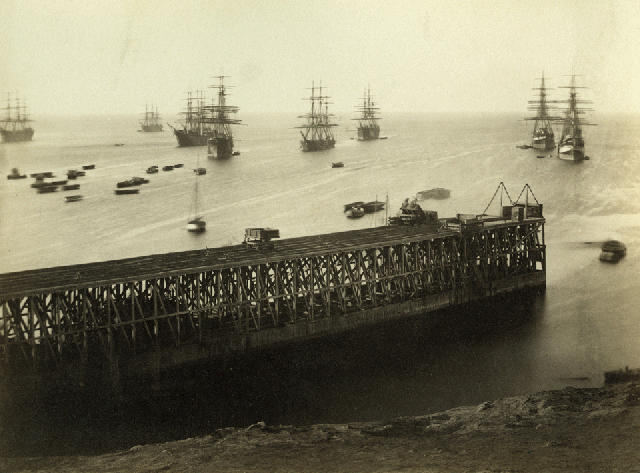 |
| Ships involved with guano mining operations, Chincha Island Harbor (New Bedford Whaling Museum) |
Having completed our laying days and received a full cargo (911 tons) we attempted this morning to get up our forward and stern moorings. We worked the whole day, endeavouring by every means to clear the starboard bower anchor which had got foul of the stern moorings of our neighbour, the Italian Barque “Elvezia”. However, we found it impossible to get away today.
Sep 3rd 1866 (Sunday) [probably the 2nd]
This morning we were more successful and, at 10am, got under way for Callao.
Sep 4th 1866 (Tuesday) [now he’s got it right!]
After 2⅓ days of fair winds – though very light – we arrived and anchored in Callao Harbour at 6am.
Sep 6th 1866 (Thursday)
The Captain has paid off the Chinchas crew and shipped another for home. They came aboard today and, from all appearances, look like men capable of performing their duties (which bye the bye are not of the simplest kind) in a voyage round Cape Horn or, as it is generally called “The Horn”.
We have now aboard 15 hands all told and this is considered by the Captain to be a sufficient complement. They are the Captain, the Chief Mate, the Carpenter, Sailmaker, Steward, Cook, Boy and eight seamen.
Sep 9th 1866 (Sunday)
Sailed from Callao at noon – homeward bound.
Sep 13th 1866
 |
| Cape Pigeon (Wikimedia) |
Hooked five cape pigeons and, the following day, skinned and cooked two of them.
Oct 1st 1866
Hooked eight gulls and kept them on deck for several days.
Oct 8th 1866
Exchanged signals with the fine clipper ship “Swallow” from Callao bound for Hampton Roads53 for orders. She passed us in fine style and, two hours after signalling, was quite out of sight.
Oct 11th 1866
Rounded Cape Horn and altered course to E.N.E.
Oct 14th 1866 (Sunday)
Experienced a heavy gale of wind, shipped an immense quantity of water and had to knock out portions of the bulwarks to let it out. From half past 4am to 9pm we were busily engaged in baling out the cabin.
Oct 19th 1866
My birthday – and a most miserable one. The bad weather still continues and everyone is anxious to see a change. A great deal of huano has come up these last few days when pumping ship. Some expect to find the cargo in a very bad condition.
Oct 21st 1866
The skipper caught a fine albatross today measuring 12 ft from tip to tip.
Oct 22nd 1866
Saw a large, long iceberg about 10 miles astern of us. The captain and mate estimated that it could not be less than 40 miles in length.
Oct 28th 1866
Exchanged signals with the English ship “Norfolk” but, as we were sailing in opposite directions, could not ascertain particulars.
Nov 5th 1866
 |
| An outbound New Bedford Whaler (New Bedford Whaling Museum) |
A new Bedford whaler hove in sight today. We hoisted our signal “What Longitude have you?” but, receiving no reply, concluded that they had no code of signals aboard.
Nov 9th 1866
Good weather has now fairly set in. What a change from the 9th of last month when we were “tempest tossed” experiencing heavy, and to our old frail barque, dangerous weather. This was to say nothing of our own sufferings day and night from extreme wet and cold. We have for the last few days had a scorching sun and sultry weather. Scarcely a zephyr disturbed the tranquillity of the bosom of the ocean so all hands are busy painting ship along and aloft. The Captain, a naturally disagreeable and fault-finding man at the best of times, is particularly cross and severe during this weather. He is at present, to use the language of one of the men, “working them like horses and treating them like dogs”. From 5.30am to 6.30pm they are ruled with an iron hand and “worked up” continually. The address and general deportment of this “Man clothed in a little brief authority” reminds one most forcibly of those characters depicted so ably by Mrs H B Stowe in her Anti-slavery Works as Southern Plantation Overseers. The Mate, Mr Chas West, who is really a hard-working, energetic and attentive officer, though performing with the men the most menial duties in the ship, fails to give the Skipper satisfaction. Many a dirty, uncalled-for insinuation he has to take in silence from this man who, though at present his master, is in no single respect his equal either as a man or a seaman. Such a man as Captain Doyle has no right to rise to a higher position, or a more dignified occupation than that of digging turf or his native pie fruit, Irish potatoes. There is not a man aboard who entertains the least particle of respect towards him or who regards him in any other light than that of a mean, sneaking, soulless despot.
Nov 10th 1866
We have now had the Albatross aboard three weeks though, during that time, he has tasted neither food nor water. By the “old man’s” orders, killed him today.
Nov 11th 1866
At 2pm we saw distinctly, and at the same moment, Sun Moon and stars.
Nov 15th 1866
At daybreak we sighted a small brig heading about N.E. We were unable to come within hailing or signalling distance though our Captain was anxious to do so. He had been trying for the day or two past to get a sight of the Island of Trinidad so as to correct his longitude as the chronometer aboard here is considerably at fault.
Nov 16th 1866
Killed and cooked a young shark measuring 5 ft. Secured his jaw and backbone.
Nov 17th 1866
Yesterday we cooked some of the shark and some of us ate a portion for supper. The captain gave his favourite cat Tom a small quantity and this morning he found the poor creature dead. Thank goodness no person aboard has as yet experienced any sensations of sickness and, it is to be hoped, will not do so. But I have resolved never to eat such stuff again. It is evident the meat possesses poisonous qualities, if not in large quantities, at least large and strong enough to kill an animal. This theory of course does not always hold good as, for instance, a man may use tobacco in considerable quantities, and for many tears, without experiencing any unfavourable symptoms of declining health, whereas one drop of the narcotic oil has been found sufficient to kill a dog.
However, at sea, a man has to eat many things that under any other circumstances, his palate would loathe and not partake of unless compelled by the pangs of hunger. I am sure I dread to think of the quantity of filth and the number of disagreeable and obnoxious insects I have masticated and often failed to digest during the short time I have been going to sea.
Nov 25th 1866 (Sunday)
At 8am sighted two vessels right ahead and, at 8.30am, exchanged signals with one of them – a Prussian Barque bound south. At 9.00am exchanged signals with the other, a small Barque under the Portuguese flag and with passengers probably bound for Monte Video. The difference between their separate longitude accounts was 60 miles, or four hours mean Greenwich time.
Nov 26th 1866
Seventy eight days out from Callao – crossed the equator at 4.00pm. This is the fourth time I have crossed the line and I think I may safely expect, the last.
The Captain is laid up sick but, as he never sympathises with, or offers any consolation to any one else aboard who may happen to be suffering, no one feels for him in the least. I think I would be expressing the sentiments of everybody aboard if I said the wish was general to see him sooner worse than better.
 |
| A typical holy stone |
The whole crew are on their hands and knees using what sailors generally term “prayer books” i.e. Holy Stones. The “King of Delhi” says he will have every plank of the ship’s deck as bright as when they were new. I wish he may, but I doubt it!
Nov 27th 1866
At 11.00am exchanged signals with a large English ship bound South.
Nov 28th 1866
A steamer heading N.W. in sight nearly all day.
Nov 29th 1866
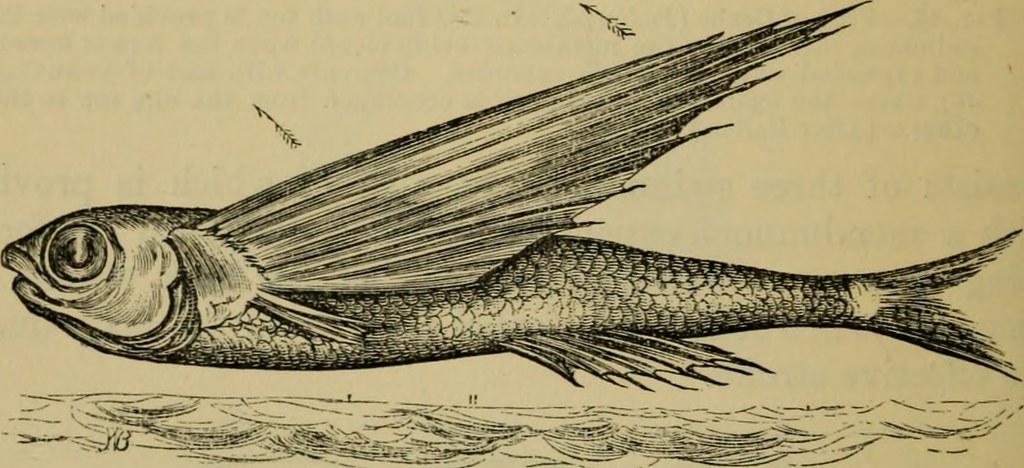 | ||
| Flying fish (exoccetus exsiliens) (Animal locomotion, Pettigrew & Bell) |
We have seen a great many flying fish, dolphin and other inhabitants of the deep. These last few days one of the former flew into the forecastle in the early watch this morning. One of the men made a breakfast of the body and I dried the wings.
Nov 30th 1866
Summers, one of the forward hands, got knocked down for his insolence and then put below in irons.
Dec 1st 1866
The captain made an entry in the case of Summers in the official log book, read it to the prisoner, then released him and sent him to his duty.
A small barque, whose nationality we did not manage to distinguish passed close on our stern at daylight.
Dec 2nd 1866 (Sunday)
 |
| Turtle with pilot fish (Flickr: Genek´s cards) |
Twelve weeks out today. A fine turtle, with three very pretty striped pilot fish, was basking astern of us today as we lay becalmed. The carpenter threw his harpoon, but missed his mark and we saw no more of his turtleship. I was much surprised to see this creature so far at sea. I was always under the impression they staid near land.
At 3pm we saw a water sprout about 30 miles on our lee quarter.
Dec 3rd 1866
A fine, brand-new, American clipper passed close to this morning at 8am. Our captain hoisted his usual 293854 (what longitude have you) but, either from inability or indisposition to answer so insignificant a looking craft as we are, the stranger displayed no bunting.
Dec 7th 1866
A number of dolphins have been displaying their agility round the bow nearly all day so, in the afternoon, I went out on the flying jib boom with hook and line. After a while I managed to catch a very fine one, but a shoal of flying fish playing around attracted the attention of the rest and I had to put up my line.
Dec 14th 1866
The mate (Mr West) has been ailing for a day or two past and today has been so unwell as to be unable to attend to his duty. He is therefore in his room. Overwork, and the brutal conduct of the Captain, have doubtless brought about his indisposition. Two strange sails in sight today but at too great a distance to communicate.
Dec 16th 1866
Fair wind, all sails and studding sails with a fair prospect of spending New Year’s day in port.
Dec 18th 1866
The favourable wind we have had the last two days would have taken us to Queenstown55 in nine days easily but unfortunately it shifted this morning to N.E. so we can only steer N.N.W.
Dec 19th 1866
Mr West resumed duty the first watch this morning.
Dec 23rd 1866
Again we have a fair wind. Every available inch of canvas is spread and the old “Delhi” is astonishing everybody by going 7½ knots and, what is better, direct for Cork. Everyone is in a good humour at the prospect of a speedy release from this miserable, monotonous state of things.
Dec 24th 1866
 |
| Pico, Azores, 1834 (Edward Boid, Day & Haghe) |
At 2am sighted the Peak of Pico one of the Azores or Western Islands. For nearly half a day we lay becalmed about three miles from land. With the aid of a glass saw the houses, churches and orange groves most distinctly.
Dec 25th 1866
Sighted St Michael’s at noon. This is the fifth Christmas from home and the fourth I have spent aboard ship. It is also the most miserable one since I left England. God grant I may never spend another such one! I cannot help thinking today what a happy season this is at home and how differently and in what comparatively comfortable circumstances all my friends in Manchester are celebrating this happy day.
Dec 29th
Mr West went aloft this morning about half past three to look for signs of some sunken rocks marked on the chart as existing in the neighbourhood of our present position and, by some unforeseen rotten state of a footrope, fell from the starboard main yard onto the deck. He was picked up insensible and his injuries attended to as far as circumstances would permit. During the afternoon he was much easier but he has doubtless hurt himself severely.
Dec 30th 1866 (Sunday)
Sixteen weeks today since we sailed from Callao. We are still 28º of longitude and about 8º of latitude from Queenstown and, what is worse, we are lying becalmed. Several very large black fish (though I have seen smaller whales) were playing close alongside today. We could not catch them or kill them, they being large enough to run away with the ship if we made a line fast to them.
Jan 1st 1867
Our hopes of being able to spend this day in port have been blighted. We are within a few day’s sail of Cork, but the sails are flapping lazily and we shall not get home in a year at this speed.
Jan 2nd 1867
At breakfast time today we got a breeze and managed to go 5 knots on our true course the whole day. I see the noble captain has written in the ship’s log “God grant all a happy and prosperous New Year”. The sacrilegious wretch – ten minutes after writing the entry he was threatening to jump the life out of one of the men and consigning to eternal Perdition the souls of two more of the crew.
Jan 3rd 1867
Heavy gale of wind blowing all day. Under close-reefed top sails. Two masts floated by us this morning. There was a tremendous sea running and it is not unlikely there has been “some of a blow” here recently.
Jan 4th 1867
What a wondrous change from yesterday. Not a breath of wind to speed us on our way.
Jan 5th 1867
At 2am commenced to blow and by 10am we were experiencing a most terrific gale. Ship under lower topsails and fore staysail and going 7½ knots. The decks continually flooded with water. A great quantity of huano coming through the pumps. The waves are really mountains high and the whole ocean around us has the appearance of a vast, seething, angry body. The wind (which fortunately allows us to go our course) carries with it a continuous shower of spray, drenching one to the skin in a few minutes.
Barometer 28º 9”.
Jan 6th 1867
Several more ships’ spars floated by today. Mr West resumed duty. Gale abated somewhat.
Jan 7th 1867
 |
| A ship in heavy seas off the Irish coast (Charles Ellms) |
Another furious gale. The Captain and Mate both agree in saying they never saw so severe an one. Ship under lower topsails and fore topmost staysail. At midnight the wind was rather lighter so we set reefed mainsail and spanker56.
Jan 8th 1867
At 7am the wind blew strong from N.W. and enabled us to steer our course after wearing ship57.
Jan 9th 1867
Strong breeze from N.W. all day. Position by observation yesterday was 48º 56” N latitude, 18º 34” W longitude. Course and distance to Cape Clear by 366 miles and to Queenstown ditto 426 miles [Cape Clear is on Clear Island which is 5km off the southernmost point of Ireland]. With any kind of favourable weather we may expect to get in this week surely.
Jan 10th 1867
Four years ago today since I landed in Vancouver Island. Oh! how they have been wasted. What lost time, energy and constitution I have to lament. Again I approach my native land poorer than when I left with so many golden anticipations. Alas! Youth has fled and with it the sanguine hopes so characteristic of that season of a lifetime. The world appears now as it is.
Jan 12th 1867
At 8am a small outward-bound Mexican brig passed close on our bow. We hoisted our 293854 but received no reply.
Jan 13th 1867
At 9am exchanged signals with an English Barque bound to the West Indies. Found their longitude to be 10º so we have only about 42 miles Easterly to make to Cork.
For the last 8 days we have had an incessant heavy sea running and the old barque ships so much water when rolling that we have been unable to pass fore and aft the decks without getting up to our waists in water. At this season of the year the water is not particularly warm and we have no means whatever of drying our clothes. This weather is particularly miserable. I have suffered more from cold and wet this week than I remember to have done in the whole course of my life.
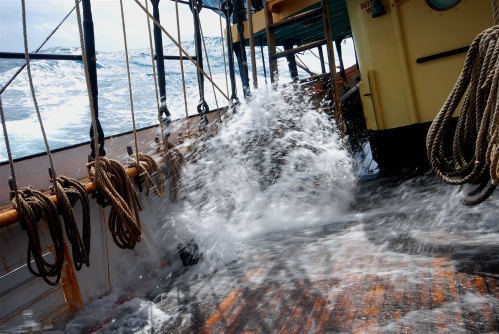 |
| Water on deck (Voyage Journal) |
From 6am to 8 or 9pm wading about in water and then called out every night to assist to “go about”, putting on cold, wet clothes and going on deck for an hour amid snow, hail, wind and rain. These things are anything but pleasant but there is no alternative. Not a murmur must escape my lips or I am cursed like a dog and spat upon like the earth. The poor cook has been most brutally and inhumanly used these last few days. He has been knocked down, kicked and struck with a capstan bar and other dangerous weapons – all unjustly and by the Captain who considers himself to be a gentleman and a Christian. No wonder we have such bad luck with winds. The Devil himself, in human shape, is our ruler.
Queenstown, Ireland: 51º 54½” N latitude, 8º 29” W longitude
Cape Clear: 51º 25” N latitude, 9º 29” W longitude.
Jan 15th 1867
 |
| The Fastnet Rock: the most southerly point of Ireland (Wikimedia) |
At 5am we sighted the Fastnet Rock off Cape Clear but, as the wind was Easterly and strong, we had no chance to beat in.
Jan 16th 1867
The Captain made a disturbance with the Sailmaker – calling him very offensive names, all of which the Sailmaker returned with interest. There was then a scuffle on deck and the Captain got his face well scratched. There was every prospect of a “general row” when the Skipper fetched his pistol on deck and, striking the Sailmaker in the face with the muzzle, pulled the trigger. Fortunately the cap did not explode and thus this bold, bad man was accidentally, and one might say, providently spared the consequences of the commission [i.e. committing] of murder. For it was evident that it was his intention to kill at least one man.
The sailmaker was afterwards put in iron and confined in a state room in the cabin and the Captain ordered him bread and water daily [the usual naval meaning of state room is a superior cabin so the words in the cabin are superfluous].
Jan 17th 1867
We are close to our port of destination but cannot beat in on account of the strong Easterly wind. We had a pretty severe snowstorm today, and with it came a number of small land birds. Doubtless they were blown from the land by the strong seaward breeze.
At 11.30pm sighted the light at Kinsale.
Jan 18th 1867
At 1 pm a Cork pilot boat came alongside and put a pilot aboard us. Oh! How pleased everybody aboard was to see a stranger on deck. One hundred and thirty one days and fifteen of us have looked upon each other ‘till every form and countenance aboard is stereotyped on the mind’s eye of every one of us.
Jan 19th 1867
The wind from the East, which has been delaying us so long, blew ‘till it became a heavy gale today, and the pilot put to sea.
Jan 20th 1867 (Sunday)
God! What a day this has been to us all. Everybody has trembled. The gale, we hope and pray, has reached its height. We are under close-reefed topsails. Three staysails blown away in an hour. The pumps manned continually day and night. The ship leaking badly. The sea mountainous high and the wind most terrific. It is with difficulty the two men at the wheel manage the helm.
Jan 21st 1867
The gale has not abated one jot and we are all really astonished to see the old barque stand it so bravely. God grant that she may weather it out.
Jan 22nd 1867
Wind this morning strong from the East but, thank God, the gale has passed. We find we have drifted a long way to S. W.
At 8am tacked ship and stood in towards Cape Clear.
At 4.30pm sighted land – but the pilot did not know what point it was. We were within a quarter of a mile of the land. The wind and tide against us at 5pm. When the captain saw little or no chance to save the ship. We were fast drifting on to the rocks when the men made for the boats.
The Captain ordered every man away and hardly had he done speaking when the wind suddenly hauled round and we were thus miraculously saved – for no boat could have been managed in such a sea under such adverse circumstances. I fervently and most sincerely thank God for this manifestation of His Providence and Mercy. I really believe that a ship never went to sea with 15 more wretched and sinful souls than we have aboard here.
Jan 23rd 1867
This should be a red-letter day in my calendar. 136 days out when, at 12noon sighted the old Kinsale Head. At 1.30pm passed Roche’s Point and, at 2.30pm, were safely at anchor in the harbour of Queenstown.
 |
| SS City of Washington (Official illustrated guide to the North-western railway) |
The SS “City of Washington” from New York had passed us in fine style this morning within about ¼ a mile of us. At 4pm the Pilot went ashore. I took the opportunity of sending ashore three letters to tell my friends of my arrival.
Jan 24th 1867
We are all glad to find no orders awaiting the ship for we are loath to go to sea in her again. Several of the chain plates are loose and the hold is in a dreadful condition – both sides and aft being completely chocked with water. The cargo is nearly all spoiled and we fear she will never pay her expenses. Several ships are discharging guano at Cork and we are all in hope that we may get orders for the same place.
The Captain thought proper to release the sailmaker today and he has resumed his duty.
What a splendid harbour this is! Indeed the Beauties of the “Cove of Cork” have long ago formed a subject worthy of the pen of a poet.
 |
| The Entrance to Cork Harbour. 1859 (The tourist's illustrated hand-book for Ireland) |
The shipping business here is very extensive – a great many vessels, both sail and steam, entering and leaving the port daily. The pretty little pilot and revenue cutters here command a great deal of admiration, their sailing qualities and general appearance are something really beautiful to look upon.
I have today seen what I have never saw in any port, namely women instead of men plying the business of “burn boats”. These daughters of Erin [Anglicisation of the Irish word Éirinn, loosely meaning Ireland] (though some of them look old and haggard enough to be mothers of the Country) climb up the ship’s side with all the agility of a sailor boy. They have done a pretty good stroke of business aboard here today.
The sailors forward are paying them most extravagant prices for very inferior goods. One or two of them have already spent nearly every penny due to them for the months of suffering and hardships they have undergone since we left Callao. They paid 45/- for a pair of boots for instance.
Jan 25th 1867
When the Captain came aboard today the crew assembled and told him they did not consider it safe to go to sea again in the ship and asked to see a magistrate in order to have a survey of the ship and cargo. Captain Doyle refused to grant their request and the men quietly resumed duty.
Jan 28th 1867
Received two letters from home, one informing me of the serious illness of my dear mother, the other one scattering at once to the winds the castles58 I have been building for five years. The prospect of a happy old age has become at once dark and gloomy and henceforth I cannot but regard women as false and unfaithful in all matters wherein affections are concerned.
Jan 31st 1867
Went ashore with Captain Doyle and received my discharge. Staid all night at the house of Mr O’Connor.
Feb 1st 1867
Went aboard the “Black Prince” and, at 2pm, left Queenstown in the steamer “Halcyon”.
Feb 2nd 1867
 |
| The New Landing Stage, Liverpool and Victoria Station, Manchester (Official Illustrated Guide to the North-western Railway, 1859) It was a five-minute walk from the station to Henry's home at 18, Cheetham Street |
Arrived in Liverpool at 6pm and took the 6.40pm train to Manchester. Arrived home at Cheetham St at 10pm after an absence of Four Years and Five Months a wiser if not better man.
Did Henry do well by getting away from Victoria as soon as he did?
One of the passengers who had sailed to Victoria on the Robert Lowe was Charles Monro. Unlike my great grandfather, he was still in British Columbia a year after the ship arrived. But, as shown by a letter to his mother he had not enjoyed his time there.
The letter appeared in several newspapers including the Kentish Chronicle, the Gravesend Reporter, North Kent and South Essex Advertiser, the London Evening Standard, the Glasgow Morning Journal and the Glasgow Saturday Post and Paisley and Renfrewshire Reformer. In the cases of the Kentish Chronicle and the Gravesend Reporter there was a short introductory passage by a Mr Macdonald of the Royal Exchange, London, who was the person who had submitted the letter. Mr Macdonald wrote that:
Your publishing in your journal the subjoined the letter from the nephew of a friend of mine in the India office would not only be obliging to me as verifying my book on “British Columbia and Vancouver’s island” to the letter, but the kindness to the poor emigrating population of this country as warning them from being over-sanguine in those remote regions as a suitable [place] of settlement.
Within the last 12 months scores of letters have been offered to me for publication, which, however, I declined, because I was not certain of the position of the writer. In this case I know Mr Munro to be an energetic, courageous, and plucky fellow, who would not be out of employment for an hour if he could help it, and who certainly would not “fold up his hands and stall rather than put his hands to any honest work”.
Within the last 12 months scores of letters have been offered to me for publication, which, however, I declined, because I was not certain of the position of the writer. In this case I know Mr Munro to be an energetic, courageous, and plucky fellow, who would not be out of employment for an hour if he could help it, and who certainly would not “fold up his hands and stall rather than put his hands to any honest work”.
The book referred to British Columbia and the Vancouver's Island, by Duncan George Forbes Macdonald is of interest on its own account.
The letter follows:
Victoria, Vancouver's Island, Feb 4th, 1864
My dear Mother,
At last I begin my long-wished-for letter, for such I know it is to you. I daresay you have not been able to account for my long silence, but I have been knocking about so much here that I have hardly had time. I have been living in the bush, working as a farm labourer for six months past. I have also been to Gold Stream diggings. Since I have been here I have done everything to get a living – at times half-starving, at times plenty; at one time I was two days and a half without grub.
When I first arrived, on the 10th of January, 1863, it was mid-winter – snow several feet deep on the ground, and no work to be had for love or money. In fact, the place was quite played out, and by the time I had used my money I was in a pretty hard fix.
The first job I got was from Bishop Hill, who gave me some work on his land. The next was driving a waggon at a soda water manufactory. The next digging ground for a nigger – the next minding and grooming horses for a Yankee, the next as a day labourer, the next selling seeds on commission, then working at the ' mines,' and making nothing of course, as is always the case with ' outsiders’. One finds a little ‘pay dirt,' and the country is 'marked out' directly for ten miles or so, and a chap gets no change.
I have been poll clerk here once at an election. Sometimes there are plenty of dollars, at others there are none. Now 1 cannot get anything to do, and I am pretty hard-up. I know not what to do next. The country is nothing like what some people in the old country represent it to be. A fellow goes to Cariboo, has to pack grub and blankets on his back (601b. or 701b.), and has to tramp 600 miles over a very rough country. When he gets there, there is no work; no gold on the surface. He has to pay 6s per lb. for flour, and 4s for bacon, and that is all the stuff he gets. Besides he has to put up with wild Indians, bears, wolves, and such wild things. There is nothing but murders up country. The people are Indians, Yankees, Niggers, Chinamen, Australians, Californians, Mexicans, Chileans, and of every European nation, besides Kanakas or Sandwich Islanders.
The voyage out took about four months round the Horn. We passed within sight of Madeira, Brazil, Patagonia, Oregon, and Washington territories, and we had some severe weather. The ship's galley caught fire once on deck, and raised an alarm – you can guess, with fifty females on board. The Robert Lowe was a fine vessel, doing her sixteen knots in a stiff breeze, with nothing but topsails on, close-reefed.
Well, as I cannot get on here, I shall go down to California, Peru, or Chili, or perhaps to New Zealand or Australia. Here you see fellows who have been officers in the army, or gentlemen of some position in England, working in rags at navvies' work, dressed in old cord pants, top boots, 'jumper,' and broad-brimmed felt hat. I shall stop till I hear from you, and if you will send me the means, I'll bolt from this miserable God-forsaken place.
I have always lived either in a tent, log-house, or lumber shanty. Wages are very poor here – it is no country without capital. If you have that you can make money. It is an awful country for colds – a great swamp in winter, and summer, it is nothing but rock, swamp, and forest. There is no farming ground hardly – all grain and vegetables come from Oregon and California, two of the finest farming countries in the world, much cheaper than they can be grown here. I don't know a soul here, nor have I ever met any fellow townsman. There are about thirty men to one woman in this place. I have a bad cold on my chest now for four days, and don't know when to get rid of it, &c.
I remain, &c,
Charles Edward Monro.
At last I begin my long-wished-for letter, for such I know it is to you. I daresay you have not been able to account for my long silence, but I have been knocking about so much here that I have hardly had time. I have been living in the bush, working as a farm labourer for six months past. I have also been to Gold Stream diggings. Since I have been here I have done everything to get a living – at times half-starving, at times plenty; at one time I was two days and a half without grub.
When I first arrived, on the 10th of January, 1863, it was mid-winter – snow several feet deep on the ground, and no work to be had for love or money. In fact, the place was quite played out, and by the time I had used my money I was in a pretty hard fix.
The first job I got was from Bishop Hill, who gave me some work on his land. The next was driving a waggon at a soda water manufactory. The next digging ground for a nigger – the next minding and grooming horses for a Yankee, the next as a day labourer, the next selling seeds on commission, then working at the ' mines,' and making nothing of course, as is always the case with ' outsiders’. One finds a little ‘pay dirt,' and the country is 'marked out' directly for ten miles or so, and a chap gets no change.
I have been poll clerk here once at an election. Sometimes there are plenty of dollars, at others there are none. Now 1 cannot get anything to do, and I am pretty hard-up. I know not what to do next. The country is nothing like what some people in the old country represent it to be. A fellow goes to Cariboo, has to pack grub and blankets on his back (601b. or 701b.), and has to tramp 600 miles over a very rough country. When he gets there, there is no work; no gold on the surface. He has to pay 6s per lb. for flour, and 4s for bacon, and that is all the stuff he gets. Besides he has to put up with wild Indians, bears, wolves, and such wild things. There is nothing but murders up country. The people are Indians, Yankees, Niggers, Chinamen, Australians, Californians, Mexicans, Chileans, and of every European nation, besides Kanakas or Sandwich Islanders.
The voyage out took about four months round the Horn. We passed within sight of Madeira, Brazil, Patagonia, Oregon, and Washington territories, and we had some severe weather. The ship's galley caught fire once on deck, and raised an alarm – you can guess, with fifty females on board. The Robert Lowe was a fine vessel, doing her sixteen knots in a stiff breeze, with nothing but topsails on, close-reefed.
Well, as I cannot get on here, I shall go down to California, Peru, or Chili, or perhaps to New Zealand or Australia. Here you see fellows who have been officers in the army, or gentlemen of some position in England, working in rags at navvies' work, dressed in old cord pants, top boots, 'jumper,' and broad-brimmed felt hat. I shall stop till I hear from you, and if you will send me the means, I'll bolt from this miserable God-forsaken place.
I have always lived either in a tent, log-house, or lumber shanty. Wages are very poor here – it is no country without capital. If you have that you can make money. It is an awful country for colds – a great swamp in winter, and summer, it is nothing but rock, swamp, and forest. There is no farming ground hardly – all grain and vegetables come from Oregon and California, two of the finest farming countries in the world, much cheaper than they can be grown here. I don't know a soul here, nor have I ever met any fellow townsman. There are about thirty men to one woman in this place. I have a bad cold on my chest now for four days, and don't know when to get rid of it, &c.
I remain, &c,
Charles Edward Monro.
London Evening Standard, 30/04/1864
Did my great-grandfather play fast and loose with the facts?
From a reading of Henry Taylor's Journal there's no doubt that he did not go to the goldfields of British Columbia. He was certainly responding to the advertisement for a passage on the Robert Lowe in which the goldfields were mentioned and, early in the journal, he refers to them twice. But that's it. There's no account of actually going there and he didn't spend enough time in Victoria to have made the return trip anyway. Nonetheless, responding to a correspondence in the Daily Telegraph during July 1867, he wrote the following letter:
MARRIAGE OR CELIBACY?
In 1862, being a clerk in receipt of a beggarly salary, and with the most gloomy of prospects, I decided on leaving England and seeking my fortune in foreign lands the success I had a poor chance of in my native country. After many inquiries and some little anxious hesitation, I chose British Columbia as my destination. Going out as a steerage passenger, I had ample opportunity during a long and tedious voyage of preparing to "rough it" and I found in my subsequent wonderings that the experience gained during my first voyage did me good service. On arrival in Vancouver's Island, I presented my letters of introduction to some of the best houses in the colony. I hardly need tell you, Sir, what in almost every case where I expressed my hope of obtaining employment in a similar capacity to what I had been accustomed to, I met with the same answer: We are glad to see you, but think you have acted imprudently in venturing here. We do not need clerks, but we need skilled artisans, farmers, and capitalists." I was soon glad to obtain work at what the colonists were pleased to call road-making. In the same "gang" with myself I could count twenty-three young Englishmen, many of whom had received university honours, and one young gentleman who had "walked Guy's" six months. After some months at this job, and being probably actuated by the same feelings that lent such wonderful impetus and zeal to hundreds of others like myself, I disposed of nearly all my valuables, including my clothes (save what I stood in), in order to raise sufficient money to try the gold diggings. At the end of a most miserable journey of 500 miles, over some of the roughest and most uninviting countries in the world, with weary limbs, a half-starved stomach, and a nervous apprehension of Chinook Indians lurking behind every nest of foliage, I landed in the British El Dorado. Some months of the hardest manual labour, together with a knowledge of the fact that I was not earning the salt I ate to my beans, convinced me that my best course would be to leave mining to those who like it, and to return to the pale of society.
I next visited a small port in Washington Territory and then went to San Francisco. Here I exhausted all my means in endeavouring to meet with employment commensurate with me abilities. I even had to apply to her Majesty's consul for pecuniary assistance. I succeeded (?), however, in obtaining work in one of the meanest and most plebeian capacities. Staying two years in California, and being constantly on the lookout for a chance to better myself, I often met with young men who related similar experiences to mine own, and felt convinced of the fact that when a man leaves England under circumstances akin to mine he must, if he hope for success, make up his mind to take hold with a will on whatever turns up first. Even then his chances are not a whit better than he leaves at home.
I afterwards visited Chili and Peru, where I experienced the same difficulties in obtaining employment, together with the additional obstacle of my ignorance of the Spanish language. After many weeks of privation and severe hardship I thankfully accepted a berth as steward of a homeward-bound English vessel. Talk of the grievance of City clerks! Why had any of them to submit with patience to the indignity continually imposed on me during my voyage home, they would sit down to their desks with a firm determination to do their duty in the condition it had pleased God to place them, and to leave roaming to those who know what it means, and the many inconveniences attendant upon such a course. On reaching home I gratefully accepted the first clerkship I was offered, and have now married and settled once and for all in the land of my fathers. Perhaps, by way of encouragement to those of your readers who have thought much about this emigration question, I may tell them that during my five years abroad I filled, at various times, the situations of navvy, cold miner (sic), ship's cook, ship's steward, labourer in a coal mine, ditto in a saw mill, waiter in a restaurant, and man-of-all work. Mine was not a solitary case. Take, for example, the passengers who left London with me – some 200 in all. Among them were men belonging to almost every class of mechanics, clerks, warehousemen, and some few professional men. Before leaving home I had seen many of them in far worse circumstances than my own, and I never met with but two who did not regret deeply the step they took in emigrating. I should advise your correspondent "Clericus" at once to doff his "bands and gown" and try a foretaste of that which, as their "self-denying pastor" he would ruthlessly lead many young men into without having the remotest idea of the consequences. The letter from "Antipodes", dated the 16th inst., is the most sensible I have seen in your columns, and I trust it will receive some consideration from intending emigrants. In a few words – don't try unless you have either a good useful trade in your hands, with money to back it, or have capital at your command with the requisite judgment for its investment.
ROAMER RETURNED
Daily Telegraph, Tuesday 21 July, 1867
Make of it what you will!
Passenger list of the Robert Lowe
The Robert Lowe set sail from the Shadwell Basin on 17 September 1862 and arrived in Esquimalt Harbour on 11 January 1863 with the following passengers:
First Class — Mrs Foster,
family with servant, Mrs Denny, T Wood, Mrs Wood, family and servant, three
Misses Legate. Rev W S Reece, Mrs Reece, Dr John Ash, L Kueller, T D A Milne Gibson,
Mr and Mrs. Leonati.
Second Class —Charles and
Mrs Hounslow, Robert and Mrs. Ewing, Mrs Wood, Mrs Hayward, S I Abington,
G B McNichol, J Jones, J James Leadbeatter, C Baker, B Bates, W E W Williams, P McNichol.
Third Class —John
Jones, Margaret N Vaux, Sarah Bragg, Chas Bragg, Peter McNichol, Finlay P Mackay, Henry Dinscombe, Rich
Andrews, Hugh Lamont, Jos Nowell, Chas B Smallbones, Sarah Smallbones, Mary A Smallbones,
C B Smallbones, Alice Smallbones, Ann Lee, Henry Mason, Arthur Churton, William
Morris, Adam Cuming, Ham Cuming, Walter Hogg, Francis Little, Francis Passingham,
Arch B Stewart, Francis Saunders, John Winger, Maria Winger, J Winger, F M Winger,
W Blythe, M Blythe, R C Coleman, Ignace Kobierzychi, Noah Shakespeare, Thomas
Lloyd, J Evans, J B Harris, James Wilson, William Jones, Fred Jones, Harry Jones,
David Brower, Alex C Piram, George E Thompson, J Harper [this could have been John Harper], James Wardle, D Bigley, M
Bigley, E Newton, W Perkins, Mrs Perkins, J Hancock, Robert Nesbett, Henry Meller,
Ernest Hilton. Abel Bewick, Thos Lee, Chas B Tennell, Henry D Sanders, Isaac
Johns, Edgar Dunn, John William Collings, William Collings, John Bagnall, James Boase, John
Smith, Ann Baines Smith, John C Smith, George H Smith, Ann Elizabeth Smith, Diaon
Cook. William Cook, Henry Pryor, Chas E Monro, Jane Morris, Horace Whiting, Fred I
Waterman, Fred W Paine, George Thompson, James Reddish, William Dundas, David Dundas,
Ellen Dundas, Elizabeth Dundas, Hartley Hanson, John Hinnen,.James Brook,
Richard Ashworth, Charles A Smith, Sunon Solomons. Henry Mason, David I. Brooton,
Alfred Jonzleton, John H Mason, Thomas Duxbury, William Drabble, James Brook, William
Aldrean, Grace Maxwell, Alice Thompson, J Fyvie, John Smith, Emily Smith, Frederick
Thompson, James Sheppard, J Winter, Henry Taylor, Thomas Cole, John Lewis. Edwin Kelly, William G Wignett, Math Wilkinson, Jane Atkinson, Mary Burton, Charlotte Ann Bates,
Ann Jane Bates, Jane Butler, Martha Clay, Emma Clay, Fanny Clay, Hannah Cook,
Elisasbeth Clarke, Sarah Jam Clarke, Mary Dacir, Mary Ann Digles, Fanny Dearden,
Martha Gooden, Mary Hewett, Jane Hayes, Sarah Johnson, Annie Kilroy, Emma
Lazenby, Maria Manley, Anne Mettor, Ann Murray. Ellen Murray, Rachel Page,
Betsy Parkinson, Nancy D. Preston, Emily Ridgeway, Mary Ryan, Esther Shoreland.
Charlotte Teasdale, Anne J Turner, Eliza Titser, Sarah Taylor, Marsden, Annie
Welsh, Elizabeth Wapling, William Perry, Richard Tremlett, John Boyd, Margaret Boyd,
Ed Shiaror, Mathew Knolt, Moses Webb, William Andrean.
Henry's voyages
Between September 1862 and February 1867, Henry made 9 major voyages and a number of lesser ones. His outward voyage from London to Victoria on the Robert Lowe took 114 days non-stop. During the journey from Concepcion to Lima his ship called on about 15 ports in Chile, Bolivia and Peru to load and unload various cargoes. At the time, Bolivia's territory extended to the Pacific coast but Chile annexed that part in 1883. On the main leg of his return journey from Lima to Queenstown (now Cobh) Henry worked his passage on a cargo ship carrying guano. The ship almost cap-sized off Queenstown. But when he finally reached that port he boarded a passenger ship for Liverpool.
 |
| Henry Taylor's voyages between 1862 and 1867 In order to get it onto the map, Hawaii is shown as being closer to America than it actually is. |
Conditions of use
I hereby declare ownership of all the text and all the graphic material for which the source is unnamed. Use of such graphic material, or of any of the text, is permitted without my consent for charitable or personal purposes. However, such material must not be used for commercial purposes without first obtaining my consent. Graphic material in this site where the source is named is normally embedded and may be subject to copyright. I hereby disclaim responsibility for any infringement of copyright resulting from the the use of such material by any third party.
Robert Cutts, bob@winton.me.uk


.jpeg)
